
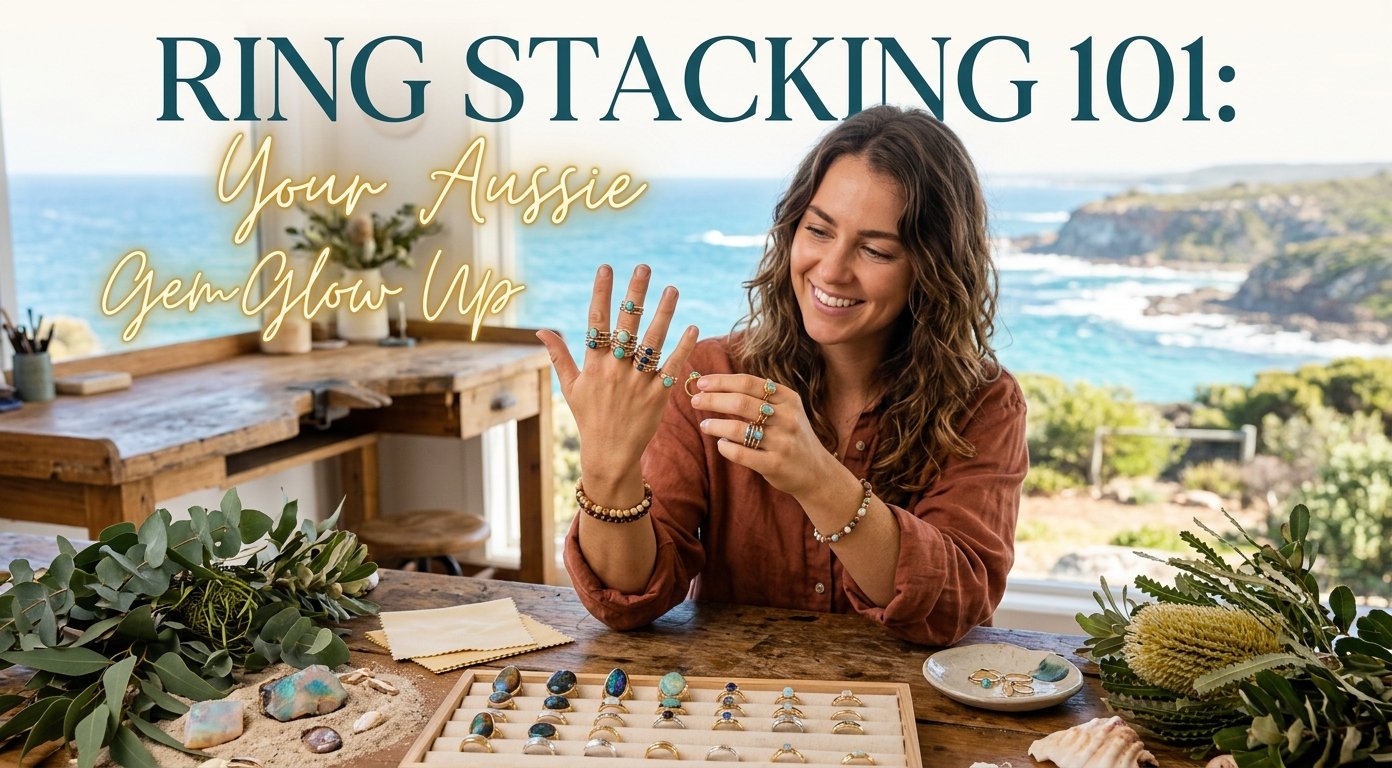
There is an indisputable, sun-drenched magic to Australian style. It is relaxed yet refined, deeply tied to the natural landscape, and effortlessly sophisticated. From the salty, laid-back shores of Byron Bay and the Sunshine Coast to the moody, laneway-chic aesthetics of Melbourne and the sunlit harbor elegance of Sydney, Aussie fashion has always embraced an authentic, unstudied glamour. Nowhere is this expressive, personal approach to style more dynamic today than in the art of ring stacking.
Transforming your hands into a personal canvas of fine jewelry is the ultimate style upgrade. Ring stacking allows you to break away from rigid single-ring traditions and build a fluid, evolving narrative across your fingers. It is interactive art you wear every single day. But while stacking may appear spontaneous on Instagram or Pinterest, achieving that perfectly balanced, non-cluttered look requires an understanding of proportion, architecture, color theory, and gemology. When you incorporate the rare, vibrant, and incredibly diverse world of native Australian gemstones—from the mesmerizing flash of Lightning Ridge opals to the captivating dual-tones of Central Queensland parti sapphires—your stack ascends from a mere trend to a signature Aussie glow up.
Whether you are starting from scratch with a clean slate or looking to breathe fresh, contemporary energy into heirloom pieces sitting in your jewelry box, this ultimate masterclass will take you step-by-step through the rules, techniques, and insider secrets of ring stacking down under.
To master the Aussie Gem Glow Up, one must first embrace the design ethos that defines contemporary Australian jewelry styling. Unlike European fine jewelry traditions that often demand strict symmetry, heavy uniform sets, and monochromatic stone choices, the Australian approach thrives on organic balance, light-play, and textural contrast. An authentic Aussie stack looks as though it was collected effortlessly over time during coastal road trips, weekend vintage hunting, and celebratory milestones.
The goal is not to pile on as much gold or silver as physically possible. Rather, it is to curate a harmonious ring ecosystem where each individual band enhances the beauty of its neighbor. The natural light of the Australian continent is exceptionally bright and crisp, meaning high-clarity gemstones, vivid play-of-color opals, and rich metal textures catch the sun in spectacular fashion. By framing native Australian gems with thoughtful metalwork and strategic spacing, your hands become an illuminated extension of your personality.
Before selecting your gemstones or picking between yellow gold and platinum, every successful ring stack relies on four fundamental structural rules. Mastering these architectural principles ensures your stack remains comfortable, visually intriguing, and mechanically stable throughout the day.
Every great art gallery has a headline piece, and every great stack needs an anchor ring. Without a clear anchor, a stack can quickly look disorganized, chaotic, or top-heavy. Your anchor is typically your largest, most vibrant, or most uniquely shaped ring. It is the piece that instantly draws the eye. On a stacked hand, you should aim for one main anchor piece on your middle or ring finger. This could be a dramatic, bezel-set parti sapphire, a glowing cabochon opal, or a bold architectural signet ring. Once your anchor is placed, every other ring on that hand plays a supporting role.
Visual monotony is the enemy of a great stack. Wearing four bands of identical two-millimeter thickness stacked directly on top of each other looks flat and rigid. Instead, build rhythm by alternating band widths and setting profiles. Pair a wide, six-millimeter low-profile cigar band at the base of your finger with a whisper-thin one-millimeter threader band above it. Combine high-set solitaire stones that elevate off the finger with flush-set pavement bands. This variation creates fascinating shadows, depth, and structural dimensional interest.
Play with silhouette shapes. If your anchor ring features a soft, round, or oval gemstone, surround it with sharp, geometric angles. Chevron bands (V-shaped rings), peak bands, crown rings, and baguette-cut diamond curves are engineered specifically to hug, frame, and highlight the natural curves of central stones. Nestling a sharp, gold V-band beneath a round brilliant Australian gemstone creates an architectural cradle that instantly elevates both pieces.
What you leave bare is just as critical as what you cover. Negative space allows your jewelry to breathe and prevents your hands from looking overwhelmed. Do not feel compelled to fill every single digit or stack every phalanx to the knuckle. Leaving your pinky or index finger completely bare while stacking your middle and ring fingers creates an intentional, curated asymmetry. Furthermore, utilizing open-ended bands or floating gap rings on a single finger introduces slivers of skin within the stack itself, keeping the look light, breezy, and modern.
“A truly exceptional ring stack never looks forced. It is an intentional study in contrast—where rich Australian earth meets refined design, and where space is just as valuable as gold.”
The true heart of your Aussie Gem Glow Up lies in the breathtaking gemstones born from the ancient geology of the Australian continent. Incorporating native gems gives your stack an authentic story, rich color depth, and unmistakable character. Here are the premier native stones to feature in your stack:
Parti sapphires are the undisputed champions of modern Aussie jewelry design. Mined predominantly in the Central Queensland gemfields around Sapphire and Rubyvale, these extraordinary stones showcase two or more distinct colors within a single crystal—most commonly a breathtaking blend of deep ocean blue, vibrant forest green, and golden canary yellow. Because no two parti sapphires feature the exact same color split, your anchor ring is guaranteed to be completely one-of-a-kind. They are exceptionally durable (ranking 9 on the Mohs hardness scale), making them perfect for daily focal rings.
Nothing captures the mythical beauty of the Australian landscape quite like a native opal. From the mysterious, dark depths of Lightning Ridge black opals to the milky, rainbow-filled white opals of Coober Pedy, these stones exhibit a phenomenon known as ‘play-of-color.’ When set into a ring stack, an opal acts as a dynamic chameleon, flashing fiery reds, electric greens, and cobalt blues as your hand moves through light. Because opals are softer than sapphires (ranking around 5.5 to 6.5 on the Mohs scale), they pair best with smooth protective bezel settings or placed alongside guard bands that shelter them from accidental impacts.
Originating from the remote East Kimberley region of Western Australia, Argyle diamonds are world-renowned for their rare, earthy color spectrum. While pink Argyle diamonds are prized collector treasures, champagne, cognac, and warm honey-toned diamonds offer an accessible, sophisticated warm glow. Incorporating micro-pave champagne diamond eternity bands into your stack provides subtle, sparkling warmth that bridges the gap between yellow gold settings and colorful center stones.
Often referred to as Australian jade, chrysoprase is a vibrant, apple-green variety of chalcedony mined in Western Australia and Queensland. With its rare translucent emerald-to-lime hue and silky luster, a smooth chrysoprase cabochon offers a strikingly modern, pop-art contrast when stacked alongside textured gold bands and delicate diamond guards.
An outdated fashion rule suggested that silver and gold should never meet on the same hand. Modern jewelry styling has completely shattered this boundary. Mixed metal stacking is one of the fastest ways to add visual complexity, cool-versus-warm contrast, and effortless versatility to your hands.
To mix metals without looking disjointed, follow the 70/30 rule. Select one primary metal tone to dominate approximately 70 percent of your overall hand styling—for instance, warm 14k or 18k yellow gold. Then, introduce your secondary metal—such as bright sterling silver, crisp white gold, or cool platinum—at the 30 percent mark as deliberate accent bands. Alternatively, incorporate a ‘bridge piece’: a single ring that inherently features two-tone metalwork, such as a braided band of yellow gold and silver. This creates a cohesive visual link that justifies the presence of both metals across your other fingers.
If you are looking for immediate styling inspiration, these three tried-and-tested formulas reflect distinct Aussie lifestyle aesthetics:
Designed for easy beach days, sun-bleached linen, and effortless coastal living. This look relies on smooth textures, durable bezel settings, and soft organic hues.
Ring Finger (Anchor): A bezel-set oval Australian green sapphire in polished 14k yellow gold.
Middle Finger (Base Layer): A medium-width hammer-textured silver band stacked beneath a whisper-thin plain gold threader.
Index Finger: Left bare to maintain clean negative space.
Thumb: A smooth, flat-top solid silver cigar band for grounding balance.
Edgy, architectural, and dark-toned—perfect for urban coffee runs, sleek black tailoring, and evening gallery openings.
Index Finger (Anchor): A cushion-cut, dark teal Australian parti sapphire set in a heavy, geometric white gold setting.
Middle Finger (The Stack): A stacked pair consisting of an open-gap diamond baguette cuff band framed by an angular V-shaped black rhodium chevron band.
Pinky Finger: A sleek, flush-set champagne diamond signet ring.
Ring Finger: Left bare for sharp, modern asymmetry.
Rich, warm, and romantic—drawing inspiration from golden hour light, red earth, and free-spirited vintage aesthetics.
Ring Finger (Anchor & Frame): A fiery Lightning Ridge freeform opal halo ring in rose gold, framed perfectly on top and bottom by vintage-inspired milgrain rose gold lace bands.
Middle Finger (Midi): A simple polished rose gold band worn above the second knuckle.
Index Finger: A multi-stone organic cluster ring featuring tiny Australian champagne diamonds and raw chrysoprase.
When you are wearing multiple rings adjacent to one another on a daily basis, mechanical wear and metal friction are natural considerations. Gold and silver are precious metals, and over time, rings that rub together closely can develop fine surface wear. To preserve your heirloom-quality Australian gemstone stack for decades to come, observe these crucial maintenance principles:
First, pay close attention to relative hardness. Never stack a high-hardness gemstone like a diamond or sapphire directly touching a softer stone like an opal or pearl without a metal spacer band in between. The sharp facet edges of a sapphire can easily scratch the delicate surface of an opal as your fingers move throughout the day. Using a thin, plain metal band as an insulator between stone rings eliminates this risk completely.
Second, ensure your rings are properly sized for the specific digit and phalanx they inhabit. Stacking multiple bands on a single finger creates a wider overall profile, which usually makes rings feel significantly tighter. As a rule of thumb, if you are stacking three or more medium-width bands on one finger, you may need to increase the ring size of the upper bands by a quarter to half size for ultimate daily comfort.
Finally, clean your stack regularly. Because stacked bands feature multiple crevices, settings, and underside galleries, hand creams, natural oils, and dust can accumulate behind your stones and obscure their light reflection. Submerging your solid gold and sapphire rings in warm water with a few drops of gentle dish soap, then softly cleaning behind the settings with an ultra-soft toothbrush, will immediately restore that fiery, high-clarity Aussie Gem Glow Up.
Ring stacking is fundamentally a celebration of self-expression. There are no permanent boundaries, no rigid rules that cannot be thoughtfully rewritten, and no limit to how your collection can grow over time. By combining structural balance, mixed metal confidence, and the undeniable, authentic allure of native Australian sapphires, opals, and diamonds, you possess all the tools needed to build a signature jewelry look that is entirely your own. Step into the sunshine, experiment with unexpected combinations, and enjoy your ultimate Aussie Gem Glow Up.


© 2026 Gemglowup-au.com | All Rights Reserved