
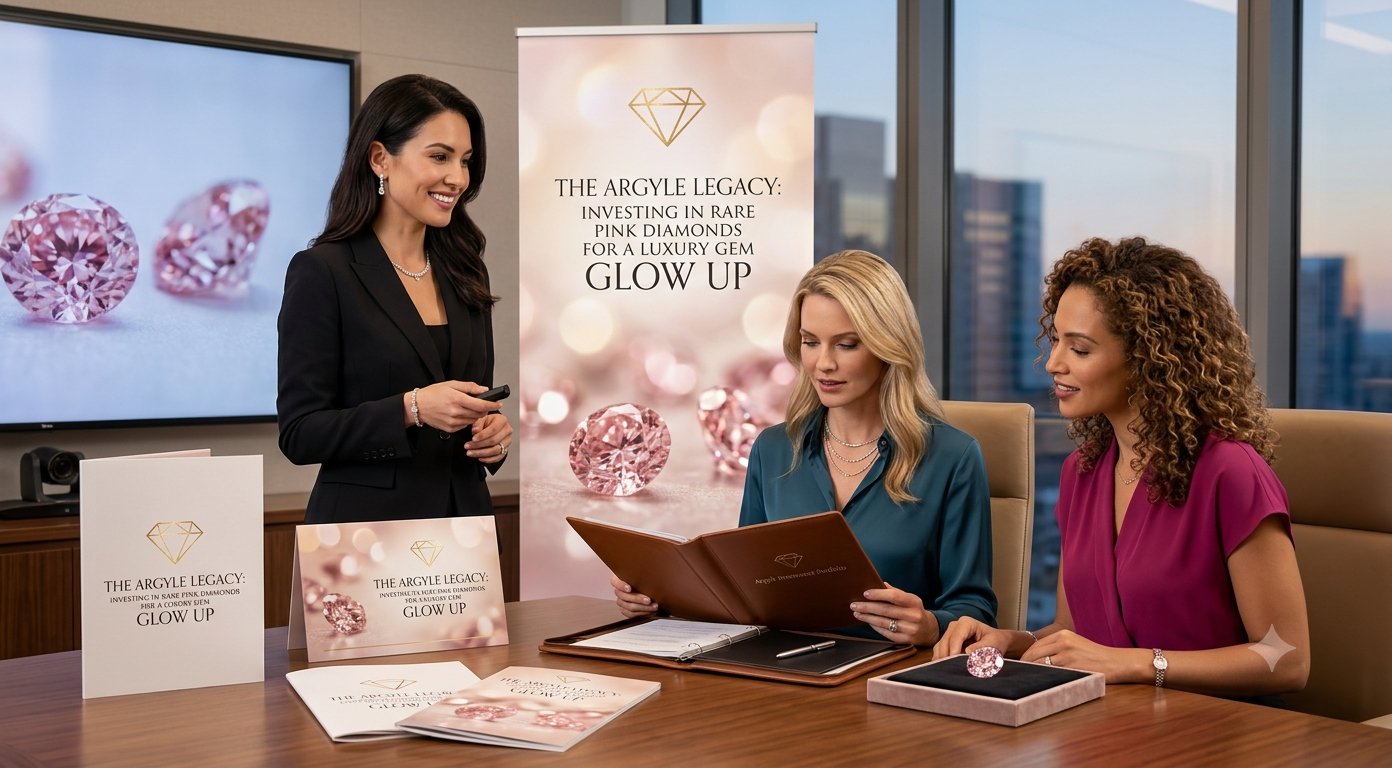
For centuries, the global elite anchored their wealth in traditional safe havens: prime real estate, sovereign bonds, and physical gold bullion. Yet, in the modern landscape of asset management, high-net-worth individuals and sophisticated collectors are looking toward a more compact, exponentially scarcer, and visually stunning asset class.
Natural pink diamonds—specifically those bearing the legendary provenance of Western Australia’s iconic Argyle Diamond Mine—have transformed from ultra-luxury collector pieces into one of the most powerful alternative investments in the world.
With the definitive closing of the Argyle Mine, the primary supply of these mesmerizing gems has permanently ceased. What remains is a strictly finite, secondary market-driven pool of wealth.
Investing in Argyle pink diamonds is not merely an alternative financial strategy; it is the ultimate luxury “Gem Glow Up.” It seamlessly merges the sophisticated world of wealth preservation with the prestige of owning a piece of geological history.
To appreciate the investment thesis of a pink diamond, one must first understand its extraordinary physical and geological anomaly.
Unlike other fancy colored diamonds, which derive their hues from trace chemical elements (such as nitrogen in yellow diamonds or boron in blue diamonds), pink diamonds contain no chemical impurities. Instead, their coloration is born from a phenomenon known as crystal lattice deformation.
[Immense Heat & Tectonic Pressure]
│
▼
[Carbon Atoms Forced Out of Alignment]
│
▼
[Structural Lattice Distortion]
│
▼
[Selective Light Absorption = Pink Hue]
During their formation over a billion years ago deep within the Earth’s mantle, intense seismic heat and structural pressure twisted the diamond’s carbon crystal structure. This physical distortion alters how the stone absorbs and reflects light, producing an array of shades from delicate blush pinks to intense magenta and ultra-rare red.
While pink diamonds can occasionally be found in small numbers across mines in Brazil, Russia, and Africa, the stones recovered from the East Kimberley region of Western Australia are globally unmatched. Argyle pink diamonds possess a unique, highly saturated, warm molecular structure that makes them look remarkably vibrant.
They are famously denser and harder than standard white diamonds, reflecting light with an unmistakable, fiery brilliance.
Yet, across its 37 years of operational history, the Argyle Mine produced more than 865 million carats of rough diamonds. Less than 0.1% of that astronomical total were naturally pink.
They represent a true rarity within a rarity.
In November 2020, the Argyle Diamond Mine officially exhausted its economic lifespan and closed its doors. The structural impact on the global gemstone market was immediate and absolute. Overnight, more than 90% of the world’s primary supply of pink diamonds vanished.
With the final, exclusive Rio Tinto Argyle Pink Diamonds Tenders concluding, the primary pipeline has officially run dry. We are now experiencing a profound structural shift:
Zero Primary Production: No new premium stock of Argyle-certified diamonds is entering the primary market.
Complete Secondary Market Transition: Every trade, acquisition, and portfolio allocation now relies entirely on finite, existing private collections and secondary dealer vaults.
Accelerating Velocity of Demand: As global wealth grows, wealth managers across Asia, Europe, and North America are actively counseling clients to diversify 5% to 10% of their luxury asset portfolios into highly portable, uncorrelated tangible wealth.
This structural reality creates an absolute floor for value. When supply hits zero and demand trends steadily upward, the pricing pressure operates on a steep vertical axis.
The financial trajectory of Argyle pink diamonds over the past two decades reads less like a traditional commodity index and more like an elite blue-chip tech stock—minus the aggressive market volatility.
According to data tracked by the Fancy Colour Research Foundation (FCRF) and independent Australian diamond brokerages, high-quality pink diamonds have consistently outperformed traditional equities, gold, and white diamonds.
2005–2010 (+120%): Global awareness expanded as sophisticated wealth funds and family offices recognized pink diamonds as a valid alternative asset class.
2010–2020 (+240%): Accelerated collector urgency intensified as the projected operational end-of-life date for the Kimberley mine approached.
2020–2026: Post-closure scarcity drove an incredible surge, with average annual appreciation hitting between 10% to 18.6%, and exceptional investment-grade specimens leaping as much as 30% within single 12-month windows during macroeconomic uncertainty.
To put this performance into perspective, look at how investment-grade pink diamonds compare to other premier asset indices over a multi-decade holding period:
Asset Class | Average Annual Return (20-Year Window) | Volatility Profile | Portability & Discretion |
Argyle Certified Pink Diamonds | 11.5% – 18.6% | Ultra-Low (Insulated from public markets) | High (Millions of dollars fit in a pocket) |
Physical Gold Bullion | 7.2% – 9.1% | Moderate (Tied to currency fluctuations) | Low (Heavy, difficult to transport securely) |
S&P 500 Index | 7.5% – 10.2% | High (Subject to geopolitical & systemic shocks) | Digital Only (Requires institutional custody) |
Fine Art & Rare Whisky | 8.5% – 12.0% | High (Subject to rapid shifts in consumer taste) | Very Low (Fragile, climate-controlled storage req.) |
Market Insight: During the economic corrections of the early 2020s, when traditional stock indices experienced sharp double-digit drawdowns, Argyle pink diamonds maintained a flat-to-positive growth trajectory. They represent a pristine, low-correlation hedge against inflationary cycles and fiat currency devaluation.
When embarking on a luxury Gem Glow Up, you must move away from the traditional “4 Cs” of white diamond grading (Carat, Clarity, Cut, and Colorless scale). In the realm of fancy colored diamonds, Color is king.
Rio Tinto established a proprietary, highly precise grading framework specifically for Argyle production. Understanding this nomenclature is vital to avoiding standard retail markups and securing true investment-grade material.
Argyle stones are divided into four primary color streams:
PP (Purplish Pink): Stunning, highly coveted stones where a distinct purple modifier enhances the depth of the pink.
P (Pink): The classic, pure rose and fallen-rose-petal tones.
PR (Pink Rosé): Softly elegant shades with a subtle, warm undertone that offers excellent relative entry pricing.
BL (Blue Violet) & PC (Pink Champagne): Rare collateral color profiles discovered within the same pipes.
Within each color category, diamonds are graded on a numerical scale running from 1 (the highest, deepest saturation) down to 9 (the lightest blush).
[1 – Vivid / Deep] ───> [3 – Intense] ───> [5 – Medium] ───> [7 – Light] ───> [9 – Very Light]
For a portfolio designed for maximum capital appreciation, target the sweet spot of color intensity:
1PP to 4PP (Fancy Intense to Fancy Vivid Purplish Pink)
1P to 4P (Fancy Intense to Fancy Vivid Pink)
Stones within these saturation bands represent the peak historical rate of compounding returns, as their visual intensity makes them highly sought-after by international auction houses and luxury jewelers alike.
Investing in rare high-value colored diamonds requires absolute precision, institutional transparency, and a verifiable chain of custody.
1.Establish an Expert Advisory Connection:Step 1: Consultation.
Avoid traditional retail jewelry storefronts, which often apply markups reaching 50% to 100%. Partner with a dedicated wholesale diamond investment brokerage or a specialized Argyle Pink Diamonds Select Atelier. This gives you direct access to deep vault stock and true trade wholesale pricing.
2.Verify the Dual Certification Stack:Step 2: Authentication.
Every authentic investment-grade stone must carry two primary documents: an official Argyle Pink Diamond Certificate bearing a unique lot number, and a Gemological Institute of America (GIA) Colored Diamond Grading Report. Ensure the physical diamond features a microscopic laser inscription on its girdle matching these certificates exactly.
3.Analyze the Monograph and Provenance Reports:Step 3: Analytics.
Review the Australian Diamond Analytics (ADA) rarity monograph. This document details the stone’s historical context, its exact placement in the original mining yield, and its statistical rarity compared to global diamond reserves.
4.Execute Secure Transaction and Logistical Handover:Step 4: Settlement.
Settle the acquisition via secure institutional channels. If taking personal possession within Australia, leverage specialized, fully insured armored logistics providers (such as Brink’s or Malca-Amit) to transition the asset from the wholesale vault to your designated depository.
For Australian investors, one of the most compelling vehicles for holding rare pink diamonds is a Self-Managed Super Fund (SMSF). Because pink diamonds are physical, non-yielding capital appreciation assets, they align perfectly with the long-term wealth creation mandates of retirement structures.
However, the Australian Taxation Office (ATO) and the Australian Securities and Investments Commission (ASIC) enforce strict compliance regulations governing “collectables and personal-use assets” held within an SMSF:
The Sole Purpose Test: The diamond must be acquired solely to provide retirement benefits for fund members. It cannot be worn, displayed, or utilized in any personal capacity by the trustees or related parties.
Strict Storage Regulations: The asset cannot be stored in a private residence. It must be kept within an approved, independent, ultra-secure vault facility (such as a specialized bullion or gem depository).
Immediate Insurance Coverage: The diamond must be fully insured under its own dedicated policy within seven days of acquisition, framed at its correct replacement value.
Independent Annual Audits: Every financial year, an SMSF holding pink diamonds must provide an independent valuation report from a registered member of the National Jewellery Valuers Association (NJVA) to confirm its current market value.
By adhering to these regulatory guardrails, Australian investors can capitalize on the favorable tax treatments of the superannuation environment while building exposure to an incredibly robust alternative asset class.
Investors often face a strategic fork in the road: should the diamond remain a loose, unmounted stone sealed inside an investment card, or should it be transformed into a custom piece of fine jewelry?
Both approaches offer unique benefits depending on your investment timeline and lifestyle goals.
For institutional investors, family offices, and SMSF structures, keeping the stone loose is the preferred option.
The diamond remains hermetically sealed inside an official security card.
It incurs zero manufacturing or design overhead costs.
It offers maximum liquidity, as international buyers can easily purchase, inspect, and reassess the stone without the stylistic subjectivity of an existing ring or pendant setting.
If you are investing outside of an SMSF structure, mounting a rare pink diamond into a piece of custom high jewelry can significantly amplify its secondary market value.
Placing a vivid pink diamond as a center stone—flanked by rare white or blue accent diamonds in a platinum or 18-karat rose gold setting—creates a wearable masterpiece.
Bespoke design work elevates the stone from an abstract commodity to a highly desirable piece of fine art. When it comes time to liquidate through premiere auction houses like Christie’s or Sotheby’s, an exquisite, signed estate piece often commands a substantial premium over the raw value of the loose diamond alone.
Because a multi-million dollar diamond portfolio can physically reside within a case no larger than a smartphone, security and preservation require careful planning.
To maintain investment-grade value, protect your diamonds from physical abrasion and environmental hazards. While diamonds are famously resilient, their polished facets can scratch if stored carelessly alongside other stones.
Utilize specialized depository vault services that offer:
Automated dual-key security access protocols.
24/7 seismic and thermal monitoring systems.
Underwritten risk coverage backed by elite global insurers like Lloyd’s of London.
An asset is only as valuable as your path to exit. While pink diamonds do not share the immediate, day-trading liquidity of public stocks, a well-structured exit strategy ensures seamless capital conversion:
[Holding Period: 5–10 Years for Maximum Appreciation]
│
▼
[Step 1: Secure Updated Independent NJVA Valuation]
│
▼
┌───────────────┴───────────────┐
▼ ▼
[Option A: Consignment] [Option B: Global Auction]
via Certified Trade Network via Sotheby’s / Christie’s
(Best for target pricing) (Best for rare Tender stones)
By working with an established trade network, investors can access international collectors ready to pay top-tier market rates for documented Australian provenance.
The closure of the Argyle Mine stands as an unprecedented event in the history of gemstone mining. Never before has an asset class responsible for nearly the entire global supply of a precious commodity shut down permanently while global demand continued to climb.
Whether you seek a resilient hedge against volatile global financial markets, a tax-efficient asset for your Self-Managed Super Fund, or a breathtaking piece of custom jewelry to pass down through generations, Argyle pink diamonds offer an unparalleled financial and aesthetic opportunity.
The primary supply is gone forever. Secure your position within the secondary market today, and elevate your wealth portfolio with the enduring brilliance of an Australian pink diamond investment.


© 2026 Gemglowup-au.com | All Rights Reserved