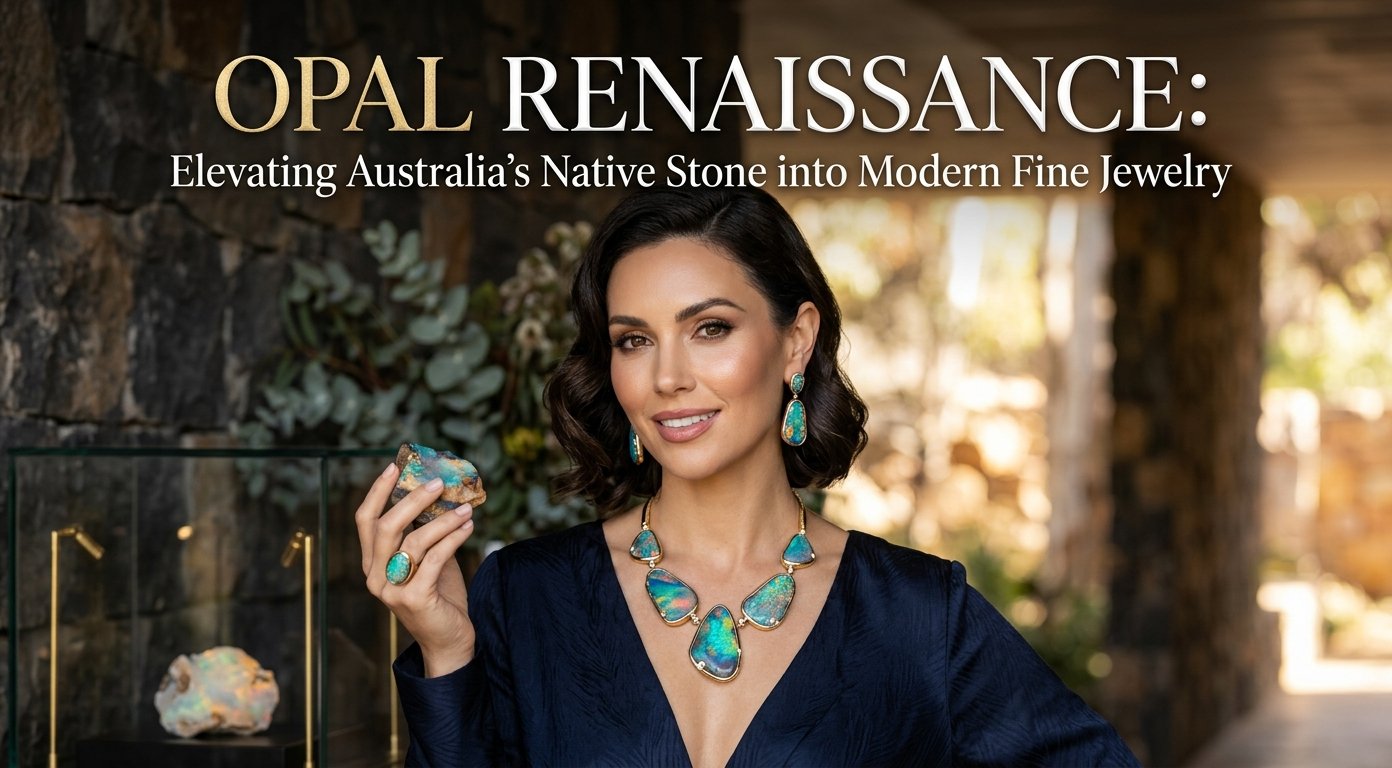
For decades, the opal occupied a curious, almost paradoxical position in the world of high jewelry. Revered by connoisseurs for its captivating play-of-color, it was simultaneously sidelined by mainstream international luxury houses that favored the predictable, uniform brilliance of diamonds, sapphires, and rubies. Too often relegated to traditional, vintage-style cluster settings, mounted in uninspired silver, or sold in tourist shops as unrefined souvenirs, Australia’s official national gemstone waited for a modern design movement that could translate its ancient, ethereal beauty into a contemporary aesthetic context.
That movement has finally arrived. The Opal Renaissance represents a seismic shift in high jewelry design, pushing the stone beyond conventional boundaries and recasting it as a premier medium for artistic expression. Led by Gem Glow Up, Australia’s destination for contemporary artisanal gems, this revival extracts the native stone from traditional design clichés and elevates it into the vanguard of modern fine jewelry. By combining cutting-edge lapidary techniques, ethically sourced solid Australian opals, and sleek, architectural metalwork, Gem Glow Up is redefining how the world perceives, wears, and collects opals.
To understand the modern opal renaissance, one must first understand the extraordinary geological conditions that created the stone. Formed over tens of millions of years across the vast, arid expanse of the Australian Outback, opals are nature’s most spectacular optical phenomena. During the Cretaceous period, a massive inland sea covering central Australia dried up, leaving behind silica-rich deposits. Over millennia, seasonal rains washed this soluble silica down into deep fractures, seams, and cavities within the earth’s crust.
As the water slowly evaporated over vast epochs, it left behind micro-spheres of amorphous silica packed together in ordered, three-dimensional grids. When natural daylight enters these microscopic sphere networks, it refracts and diffracts, splitting into its spectral component colors. This phenomenon, known as play-of-color, is unique to precious opal.
No two natural opals are ever identical. A single stone can display the vivid turquoise of the Great Barrier Reef, the fiery orange of an Outback sunset, and the electric violet of a desert lightning storm—all shifting dynamically as the wearer moves. While smaller opal deposits exist around the world, Australia produces over ninety percent of the world’s precious opal. The stones unearthed in historical mining hubs like Lightning Ridge, Coober Pedy, and the remote Queensland boulder fields possess a structural density, color intensity, and chemical stability unmatched by stones found anywhere else on Earth.
The resurgence of opal jewelry is driven by a fundamental shift in luxury consumer values. Today’s discerning jewelry collectors are moving away from mass-produced, standardized luxury in favor of individuality, authentic provenance, and artistic distinction—three pillars where the Australian opal excels.
First, modern fine jewelry wearers want absolute uniqueness. Diamonds and traditional precious stones are graded on uniform, standardized metrics of cut, color, and clarity, often resulting in pieces that look identical across different luxury houses. Precious opals, by contrast, are completely unique fingerprint gems. The precise arrangement of silica spheres, body tone, and color pattern within a specific opal cannot be duplicated by nature or artifice. Owning an opal piece means owning a singular work of natural art that no one else on Earth possesses.
Second, luxury buyers care deeply about origin and ethical sourcing. Australian opals are mined predominantly by small-scale, independent prospectors and family-run operations adhering to strict Australian environmental and labor laws. Unlike stones originating from unstable supply chains, Australian opals offer clear, transparent provenance, providing peace of mind to conscious consumers who value ethical craftsmanship.
Finally, in an increasingly digital and standardized world, the fluid, organic beauty of an opal feels alive. It does not offer a static glare; instead, it responds dynamically to lighting, movement, and context, creating an interactive visual experience for the wearer.
At Gem Glow Up, the opal is not treated as a vintage heirloom to be preserved in velvet boxes, nor as a delicate curiosity. It is treated as a bold canvas for modern architectural jewelry design. The brand’s philosophy rests on three foundational pillars: ethical Outback sourcing, minimalist structural settings, and custom lapidary artistry.
Gem Glow Up partners directly with independent miners across Lightning Ridge, Coober Pedy, and the Queensland fields. By bypassing long chains of international middle-agents, every stone in the collection comes with a verifiable chain of custody. This direct relationship guarantees that miners receive fair value for their labor while ensuring that every gem is a genuine, untreated Australian stone.
Traditional opal settings frequently overwhelmed the stone with heavy cluster diamonds, ornate prongs, or filigree patterns that aged the aesthetic. Gem Glow Up strips away decorative fluff. Utilizing clean geometric lines, flush bezels, tension mounts, and asymmetrical frames in eighteen-karat gold and platinum, the metalwork serves to highlight the stone’s silhouette without competing for visual attention.
Rather than forcing a raw opal into a standard oval shape and grinding away precious gem material, Gem Glow Up lapidary artists follow the natural color vein of each individual rough stone. This custom freeform technique maximizes the gem’s natural fire, yields striking architectural shapes, and preserves the highest possible carat weight while honoring the natural character of the raw material.
To appreciate the diversity within the Gem Glow Up collection, one must understand the distinct characteristics of Australia’s primary opal varieties.
Mined almost exclusively at Lightning Ridge in New South Wales, black opal is the undisputed monarch of the opal world. It is characterized by a dark ground color—ranging from dark gray to jet black—which acts as a natural backdrop, causing the spectral fire to pop with intense brightness. Red-fire black opals on a deep black body tone represent the rarest and most valuable class of opal in existence.
Hailing from the remote desert regions of Western Queensland, boulder opal forms within ironstone host rock. Gem cutters preserve the natural ironstone backing, creating a striking contrast between the dark brown matrix and the thin, brilliant veins of precious opal that run through it. Highly durable and naturally freeform, boulder opals are favored by designers for bold, sculptural pieces.
Mined primarily at Coober Pedy in South Australia, white and crystal opals offer a lighter, more delicate aesthetic. White opals feature a light, milky body tone with soft pastel color flashes, while crystal opals are transparent to translucent, allowing light to pass entirely through the gem and ignite a fiery internal play-of-color.
Found in regions like Andamooka, matrix opal features precious opal dispersed throughout tiny pores in the host rock. When polished, it creates a starry, galaxy-like field of sparkle across the entire surface of the piece, offering a distinctly modern appearance.
The Gem Glow Up collection showcases how modern design principles transform raw Australian gemstones into wearable sculpture.
The Lightning Ridge Solitaire: Designed around a solid Lightning Ridge black opal featuring a rare rolling green-and-blue flash, this ring strips away all extraneous ornamentation. The gem is held in a substantial, satin-finished eighteen-karat yellow gold bezel setting that lets the stone’s intense inner light take center stage.
The Queensland Freeform Pendant: This piece celebrates the raw, unrefined geometry of nature. A bold Queensland boulder opal displaying bright turquoise and royal purple color veins embedded in deep brown ironstone is framed in minimal platinum metalwork and suspended from a sleek snake chain. It balances Outback raw energy with refined urban sophistication.
Asymmetrical Ear Cuffs: Designed for modern jewelry layering, these ear cuffs pair polished Coober Pedy crystal opals with subtle, flush-set white accent diamonds. The design wraps cleanly around the ear, allowing natural light to pass through the translucent crystal opal from multiple angles, shifting its appearance throughout the day.
Every piece crafted by Gem Glow Up adheres to rigorous gemological standards. The brand works exclusively with natural, solid Australian opals. Gem Glow Up explicitly rejects synthetic opals, composite doublets, and triplets—pieces created by gluing thin slices of opal onto glass or plastic backing—ensuring that clients acquire genuine, solid investments.
Each fine jewelry creation is accompanied by a formal Certificate of Authenticity detailing the gem’s origin, body tone classification on the official N1 to N9 scale, and brightness rating on the 1 to 5 scale. Metals used in the settings consist exclusively of certified recycled eighteen-karat gold or heavy nine-hundred-fifty platinum, aligning environmental responsibility with material luxury.
Because Australian opals are solid stones formed over millions of years in dry environments, they are resilient and well-suited for regular wear when cared for properly. Contrary to common myths caused by porous Ethiopian hydrophane opals, solid Australian opals do not absorb water, turn cloudy, or lose their play-of-color when submerged.
To maintain the luster of your fine opal jewelry, clean pieces using warm water, mild soap, and a soft-bristled brush or microfiber cloth. Avoid exposing opal jewelry to harsh chemical cleaners, industrial solvents, or extreme physical impacts. Store opal pieces separately in soft cloth pouches to prevent harder stones like diamonds or sapphires from scratching the opal’s polished surface.
The Opal Renaissance is more than a fleeting fashion trend; it represents the permanent integration of Australia’s native stone into global fine jewelry culture. By freeing the stone from outdated settings and celebrating its natural individuality, Gem Glow Up invites a new generation of collectors, design enthusiasts, and jewelry lovers to experience the majesty of the Australian Outback transformed into timeless, contemporary fine art.


© 2026 Gemglowup-au.com | All Rights Reserved