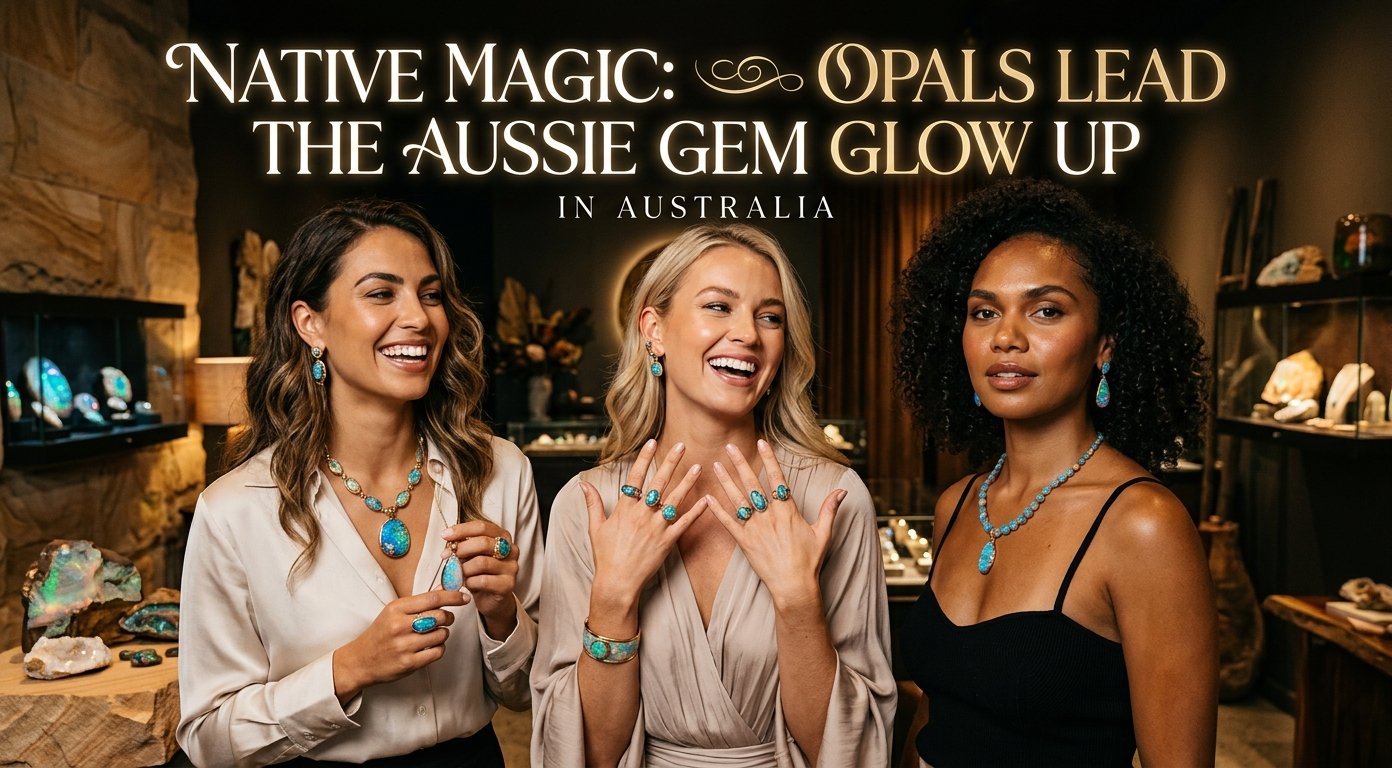
For generations, the narrative surrounding Australian opals remained quiet, almost traditional. They were the beloved stones of vintage heirlooms—delicate cabochons resting in ornate yellow gold brooches, tucked safely away in velvet keepsake boxes. But quiet traditions have given way to an explosive cultural awakening. Driven by a global movement toward individuality, non-traditional luxury, and sustainable sourcing, opals have claimed center stage in the high-jewelry world. This is the Aussie Gem Glow Up: a dynamic movement where Australia’s rich subterranean treasures are reimagined through modern design, bold metalsmithing, and an uncompromising celebration of natural art.
Australia has long been the heartland of precious opals, producing over 90% of the world’s supply. Yet today’s collectors are viewing these stones through an entirely new lens. Modern fine jewelry enthusiasts are moving away from factory-cut uniformity and uniform white diamonds, seeking instead a gemstone that possesses character, movement, and a soul. No two opals are ever identical. To hold an Australian opal is to possess a single, unrepeatable moment of geological time—an iridescent masterpiece sculpted by the earth over millions of years.
As top designers from Sydney to London and New York embrace the raw, electric beauty of these native stones, the opal is no longer seen simply as a nostalgic treasure. It has become the ultimate signature of modern, expressive luxury.
To understand the magic of the Australian opal, one must travel back over 100 million years to the Cretaceous period. During this era, a vast inland sea covered the arid center of what we now call the Australian Outback. As this ancient sea slowly evaporated over geological epochs, silica-rich waters filtered deep into the cracks, fissures, and sandstone layers of the earth.
As the climate changed and the moisture vanished, microscopic spheres of silica settled in densely packed, uniform grids. When white light hits these internal spherical structures, it undergoes a complex process of diffraction and interference. Light breaks apart into its component wavelengths, refracting a brilliant, shifting spectrum of colors back to the human eye. This captivating optical spectacle is known in gemology as “play-of-color.”
Unlike static gemstones that reflect light purely from surface facets, an opal generates its brilliance from within its structural core. The size and arrangement of those microscopic silica spheres dictate the exact shades you see. Smaller spheres produce cool, electric blues and vivid violets; larger spheres produce rare, blazing oranges and fiery, neon reds. Depending on the direction of light, an opal can transform instantly from deep navy and forest green to hot magenta and blazing gold. It is a living, shifting artwork held in the palm of your hand.
The unique landscapes of regional Australia give birth to distinctly different varieties of opals, each with its own signature personality, color depth, and structural beauty. Our fine jewelry collections are built entirely around stones directly sourced from these three legendary mining hubs:
Situated in remote northern New South Wales, Lightning Ridge is world-renowned as the premier source of the elusive Black Opal. Black opals are the rarest and most valuable of all opal varieties. The term “black” does not mean the surface of the gem is dark; rather, it refers to the deep grey to charcoal-black natural ironstone or pitch backing behind the play-of-color. This dark base acts like a high-contrast canvas, causing neon red, electric blue, sunset orange, and fiery green flashes to explode with an intensity unmatched by any other gemstone on Earth.
Stretching across the harsh, iron-rich landscapes of Quilpie, Yowah, and Winton, Queensland produces the magnificent Boulder Opal. Formed within dense ironstone boulders, these opals are naturally fused to their dark brown host rock. Lapidaries carefully cut the gem following the organic, undulating veins of opal as they wind through the ironstone. The contrast between the rugged, earthy brown ironstone and the liquid, bright neon green or royal blue opal produces breathtaking, painterly compositions. Boulder opals are inherently durable and wildly unique, making them a favorite for contemporary, avant-garde ring and pendant designs.
Nestled in the desert plains of South Australia, Coober Pedy is famous for its White and Crystal Opals. Formed in white sandstone beds, these gems feature light, milky, or semi-translucent body tones filled with ethereal, pastel rainbow iridescence. Crystal opals, which are entirely transparent, allow light to pass completely through the gem, illuminating a three-dimensional galaxy of color from deep inside the stone. Ethereal, soft, yet vibrant, Coober Pedy opals bring a romantic, glowing warmth to delicate fine jewelry settings.
The modern fine jewelry landscape has undergone a seismic shift. Modern buyers care deeply about story, origin, and personal alignment. The rising dominance of Australian opals in contemporary high fashion is rooted in three key pillars:
Absolute Uniqueness: Mass-produced luxury is falling out of favor. In a world of uniform lab-grown diamonds and factory-cut synthetic gems, the opal represents absolute individuality. The pattern of an opal—whether it manifests as broad flash, pinfire, rolling ribbon, or rare harlequin—can never be replicated by human hands or machine precision. When you wear an Australian opal, your piece is the only one in existence.
Ethical Sourcing & Traceability: Unlike many global gems mined through large-scale industrial operations, Australian opals are extracted predominantly by small-scale, family-run, independent miners. Australia maintains some of the world’s strictest environmental and labor regulations. Choosing an Australian opal means supporting ethical mining practices that respect both the land and local regional communities.
Versatility in Modern Design: Opals play beautifully with all precious metals. Set in rich, high-karat 18k yellow gold, an opal takes on a warm, ancient warmth; set in crisp platinum or white gold, its cool blues and violets radiate modern, architectural elegance. The shifting hues of the gem mean it naturally complements any wardrobe, changing its appearance under ambient dinner lighting, crisp office fluorescents, or direct midday sunshine.
The Aussie Gem Glow Up is about respecting the raw material while pushing structural boundaries. Modern Australian jewelry designers are stepping away from thin, fragile claw settings and embracing heavy, protective bezels, sculptural solid gold bands, and asymmetrical freeform cuts that follow the natural contour of the stone.
Our signature solitaire rings feature solid, untreated Australian black and boulder opals set in solid 18k gold bezels. By wrapping the gold securely around the entire perimeter of the gem, we create a smooth, sleek frame that protects the stone from daily wear while highlighting its natural geometric silhouette.
Celebrating the natural contours of Queensland boulder opals, these pendants are cut to honor the stone’s organic shape rather than forcing it into a standardized oval. Suspended from heavy gold chains, these pieces sit close to the collarbone, offering a grounding, tactile connection to the ancient Australian Outback.
For those who love layered elegance, our accent bands feature small, brilliant crystal opal cabochons alternating with conflict-free white diamonds. The interplay between the crisp scintillation of diamonds and the soft, rolling color of crystal opals creates a captivating textural contrast.
There is a common misconception that all opals are delicate or water-absorbent. It is crucial to distinguish Australian opals from hydrophane opals mined in other regions such as Ethiopia. Ethiopian opals are porous and absorb water, liquids, and oils, which can cause them to temporarily or permanently lose their color and turn cloudy.
Australian opals are non-porous. Formed over millions of years in dry, desert environments, Australian opals do not absorb water, will not turn cloudy when wet, and retain their brilliant play-of-color permanently.
To ensure your solid Australian opal jewelry remains vibrant for generations, follow these simple care tips:
Cleaning: Clean your jewelry using warm water, a mild dish soap, and a soft cloth or fine-bristled brush. Wipe dry immediately with a clean microfiber cloth. Avoid using harsh chemical solvents, steam cleaners, or ultrasonic equipment.
Mindful Wear: On the Mohs hardness scale, opal ranks between 5.5 and 6.5—similar to jade or fine glass. While durable enough for daily wear, it is best to remove your rings before engaging in heavy physical labor, weightlifting, gardening, or contact sports to protect the stone from severe direct impacts.
Storage: Store your opal pieces in a soft fabric-lined box or an individual pouch away from harder gemstones like diamonds and sapphires, which could scratch the surface of softer gems if left rubbing together.
The Australian opal is more than just a gemstone; it is a preserved fragment of Australia’s ancient geologic soul, illuminated by light and refined by human artistry. Whether you are seeking a bold engagement ring that defies convention, a meaningful anniversary gift, or a personal talisman of individuality, our collection celebrates the very best of the Aussie Gem Glow Up.
Explore our current collection of hand-mined, ethically certified Australian black, boulder, and crystal opals today, and find the one-of-a-kind stone that speaks directly to you.


© 2026 Gemglowup-au.com | All Rights Reserved