Acquiring a loose gemstone is a uniquely rewarding experience. Whether you are designing a bespoke engagement ring, crafting an heirloom piece of fine jewelry, adding to a private collection, or making a strategic investment, selecting a loose stone offers a level of personal creative freedom that ready-made jewelry simply cannot match. When you start with a loose gem, you have the rare opportunity to examine every facet, gauge true light performance, verify color purity, and confirm structural integrity without settings masking hidden flaws or internal inclusions.
However, navigating the global and Australian gemstone markets requires both clarity and sharp consumer awareness. From understanding native Australian species—such as rich central Queensland parti-sapphires and rare Lightning Ridge black opals—to evaluating complex international lab reports and subtle enhancement treatments, making an informed choice demands the right knowledge. At Gem Glow Up, our mission is absolute transparency, empowering every client with deep gemological insight and total purchasing confidence.
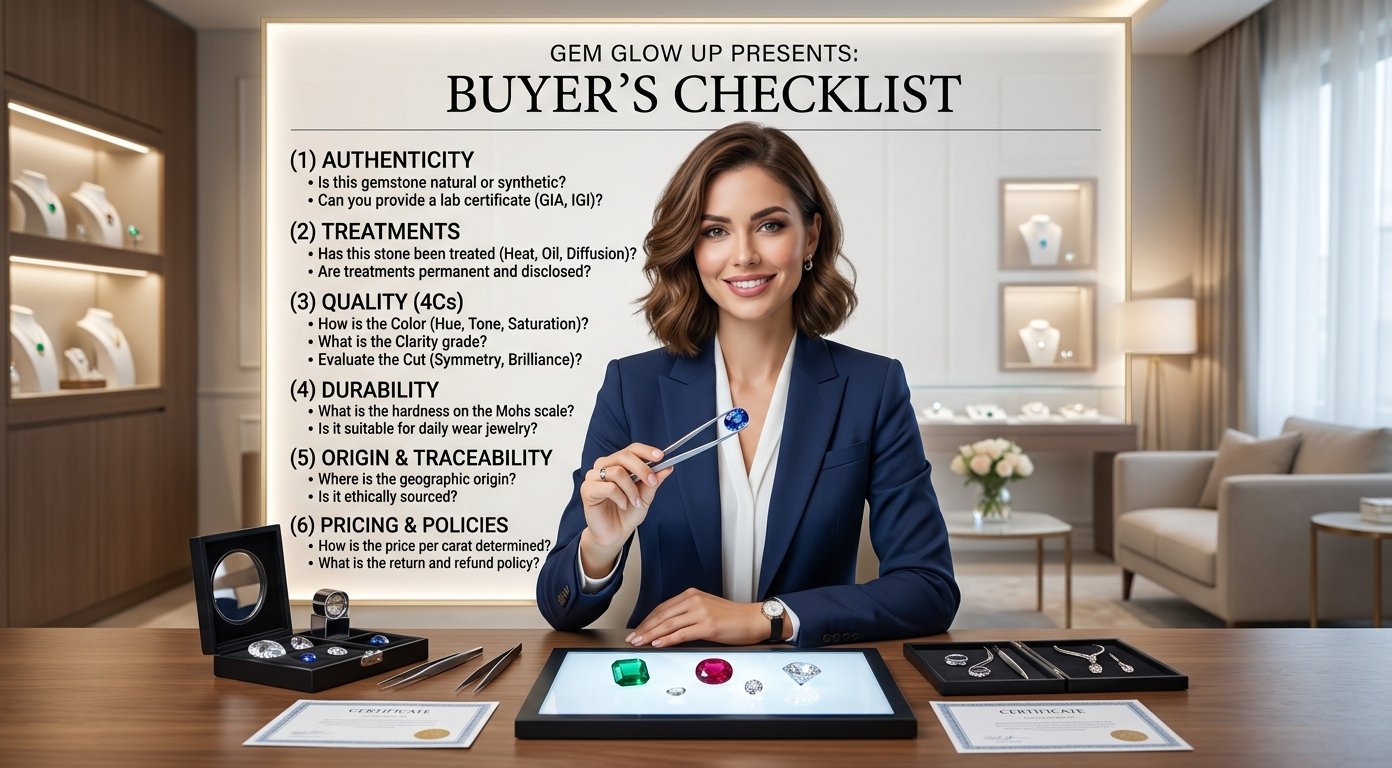
Use this ultimate guide and master buyer’s checklist to navigate your loose gemstone journey in Australia with complete clarity.
Before committing to any loose gemstone—whether at an in-person consultation in Sydney, Melbourne, or Brisbane, or via an online boutique—you should present your dealer or gemologist with these non-negotiable questions.
Always demand an explicit distinction. Natural gemstones are forged beneath the Earth’s crust over millions of years, holding intrinsic rarity and long-term resale value. Synthetic or lab-grown gemstones possess the same chemical and optical properties as natural gems but are created artificially in industrial laboratories, resulting in a vastly different market valuation.
For significant investments, verbal assurances from a seller are insufficient. Ask if the gemstone is accompanied by certification from an internationally or nationally recognized independent laboratory—such as the Gemological Institute of America (GIA), the Gemmological Association of Australia (GAA), or the International Gemological Institute (IGI).
Over 90% of colored gemstones on the market undergo physical or chemical enhancements to improve color or clarity. While standard treatments like traditional heat application are widely accepted across the trade, undisclosed treatments drastically alter a stone’s true value and durability.
Certain treatments, such as surface lattice diffusion or temporary fracture filling with colored resins, fade, degrade, or deteriorate over time—especially when exposed to household heat, ultrasonic cleaners, or bench jeweler torches during setting. Always verify that any treatment applied to your gemstone is permanent and stable.
Geographic origin plays a major role in both economic value and aesthetic appeal. For instance, an unheated Kashmir or Burmese sapphire commands a massive premium over stones from other regions. Furthermore, ethically minded Australian buyers should ensure their gemstones are mined under fair labor standards and environmentally compliant regulations.
Lapidaries sometimes cut raw rough material conservatively to preserve total carat weight rather than optimizing light performance. Ask your jeweler to evaluate the stone for symmetry, brilliance, and the presence of “windowing” (an undesirable washed-out center where light passes straight through the gem).
Not all gemstones can handle daily wear. A gem destined for a daily wear engagement ring requires significantly higher scratch resistance and toughness than a gem intended for occasional drop earrings or a display cabinet.
While most consumers understand the 4 Cs in relation to white diamonds, applying these standards to colored loose gemstones requires a specialized, nuanced perspective.
Unlike diamonds, where the absence of color drives value, colored gemstones are prized primarily for the richness, purity, and depth of their hue. Color is evaluated across three primary dimensions:
Hue: The overall body color of the stone, including any secondary undertones (e.g., a pure cornflower blue versus a violet-blue or green-blue sapphire).
Tone: The degree of lightness or darkness within the gemstone, ranging from extra light to near-black. The ideal tone for most colored stones sits comfortably in the medium-to-medium-dark range (approx. 60% to 75%); stones that are too dark look dull under ambient room lighting, while stones that are too light look washed out.
Saturation: The purity and vividness of the color. High saturation translates to intense, rich color uninterrupted by gray, brown, or black masks.
Unlike diamonds—where microscopic internal inclusions can drop value significantly—colored gemstones are evaluated based on their natural gemological classification:
Type I Gems (Virtually Inclusion-Free): Aquamarine, Morganite, Citrine, Topaz, and Green Beryl. Buyers should expect high eye-clarity with minimal to no visible internal features.
Type II Gems (Usually Included): Sapphire, Ruby, Garnet, Alexandrite, and Spinel. Minor internal feathers, silk needles, or crystal inclusions are standard, accepted, and frequently used by gemologists to verify natural origin.
Type III Gems (Almost Always Included): Emeralds and Watermelon Tourmalines. Inclusions (often referred to in emeralds as the jardin or inner garden) are completely expected; absolute eye-clarity in Type III gems frequently points to synthetic origin.
A masterfully cut gemstone will display vibrant color across its entire face without dead spots. When examining a loose stone face-up under direct and indirect lighting, watch out for two common cut flaws:
Windowing: Occurs when the pavilion angles beneath the stone are cut too shallow. When viewed straight on, the center of the stone appears see-through like a glass window, losing brilliance and color intensity.
Extinction: Occurs when pavilion angles are cut too deep, causing large sections of the gemstone to look completely black and lifeless as light becomes trapped inside.
It is critical to evaluate loose colored gems by their physical millimeter size (Length \times Width \times Depth) rather than relying solely on carat weight. Different minerals possess varying specific gravities (density). For example:
Density Comparison: Sapphire vs. Diamond
Sapphire Specific Gravity: 4.00 | Diamond Specific Gravity: 3.52
Because sapphire material is denser than diamond material, a 1.00-carat sapphire will physically measure smaller in diameter than a 1.00-carat diamond. Always rely on precision calipers to know true setting dimensions.
Enhancements are common in the gemstone trade, but full disclosure is mandatory. Understanding standard treatment methods helps you gauge true value and longevity:
Traditional Heat Treatment (Sapphire, Ruby, Tanzanite): Universally accepted and considered standard practice. Heat treatment is permanent, requires no special care, and sets the baseline market value for most corundum. However, rare unheated stones command a 30% to 100%+ premium.
Cedarwood Oiling (Natural Emerald): A universally accepted traditional enhancement. Oiling is semi-permanent and may require periodic re-oiling after years of wear or harsh cleaning. Modern resins or epoxies are also used, but heavy synthetic fillings significantly reduce market value.
Irradiation (Blue Topaz, Colored Diamonds): Widespread for producing rich colors. Irradiated stones are permanent under normal wear, though they should be protected from extreme heat exposure. The process must always be fully disclosed, though its impact on lower-cost gems like topaz is minimal.
Lattice Diffusion (Low-grade Sapphires): Moderately accepted only with full transparency. Diffusion creates a shallow, surface-level color layer that can be removed if the gem is ever recut. Stones with lattice diffusion trade at significant discounts (typically 50% to 80% lower than standard heated gems).
Lead-Glass Filling (Cavity-filled Rubies): Extremely low in trade acceptance. Cavity filling leaves stones fragile and susceptible to damage from household cleaners, lemon juice, or jeweler torches. Glass-filled stones carry extremely low market value and are classified as composite materials rather than fine gems.
Australia holds a distinguished place on the global gemological stage. When sourcing loose gems in Australia, local buyers have access to incredible native treasures alongside fine imported specimens.
Mined predominantly in Central Queensland (Rubyvale and Sapphire) and the New England region of New South Wales (Inverell), Australian parti-sapphires are globally celebrated for displaying two or more distinct colors within a single crystal—most famously zoning between deep forest green, electric yellow, and cobalt blue. Because no two parti-sapphires exhibit identical color zoning, they are highly sought-after for bespoke, one-of-a-kind jewelry creations.
Producing over 90% of the world’s precious opal, Australia offers unmatched variety:
Black Opal (Lightning Ridge, NSW): The rarest and most valuable opals on Earth, featuring a dark black or dark gray body tone that makes spectral red, green, and blue flashes pop vividly.
Boulder Opal (Queensland): Natural opal formed within ironstone matrix boulders, offering exceptional structural durability and vibrant play-of-color.
White & Crystal Opal (Coober Pedy, SA): Translucent to light-bodied opals offering delicate, ethereal rainbow flashes.
Though the historic Argyle mine in Western Australia officially ceased operations in late 2020, certified Argyle pink, red, champagne, and cognac diamonds remain top-tier investment assets globally, prized for their extreme rarity and verified provenance.
A critical step in buying loose gemstones is matching the stone’s physical durability with its intended mounting. Durability consists of three factors: Hardness (scratch resistance), Toughness (resistance to chipping/breaking), and Stability (resistance to light, heat, and chemicals).
Mohs 9–10 (Diamond, Sapphire, Ruby): Ultimate durability. Ideal for daily wear in engagement rings and wedding bands that withstand heavy hand use.
Mohs 7.5–8 (Spinel, Topaz, Aquamarine, Chrysoberyl): Excellent durability. Highly suitable for everyday rings, pendants, and bracelets with standard care.
Mohs 6.5–7 (Quartz, Amethyst, Tourmaline, Peridot): Moderate durability. Great for dress rings, earrings, and pendants; requires minor caution against hard impacts.
Mohs 5.5–6.5 (Opal, Moonstone, Tanzanite, Turquoise): Sensitive wear. Best suited for protective mountings (like bezel settings), drop earrings, or occasional-wear fine jewelry.
For daily wear pieces (such as engagement rings or wedding bands), select stones with high scratch resistance (Mohs 8 to 10). For occasional wear pieces (such as cocktail rings, pendants, or earrings), delicate gems perform beautifully when secured in protective mountings.
At Gem Glow Up, we combine deep gemological expertise with a client-first philosophy, transforming the process of buying loose gemstones into a seamless, inspiring experience across Australia.
Uncompromised Ethical Sourcing: We partner exclusively with accredited miners, ethical lapidaries, and trusted site-holders who strictly adhere to fair labor practices and environmentally conscious mining standards—prioritizing Australian-mined treasures at every opportunity.
Comprehensive Laboratory Certification: We believe in zero guesswork. Every premium loose gemstone in our inventory is backed by independent gemological certification detailing exact physical specs, chemical classification, origin verification, and full treatment disclosures.
True-Color High-Definition Digital Inspection: Online buyers never have to guess how a gemstone behaves in real life. We capture all of our loose stones under natural daylight, shade, and studio conditions using high-definition 360-degree macro video so you can evaluate color zoning, brilliance, and clarity prior to purchase.
Risk-Free Australian Shipping & Inspection: We provide fully insured, trackable express nationwide shipping throughout Australia. Receive your loose gemstone, inspect it in person under your own natural light conditions, or take it directly to your manufacturing jeweler with absolute peace of mind.
Whether you are seeking a breathtaking Queensland parti-sapphire, a vibrant natural ruby, or an investment-grade emerald, Gem Glow Up is your trusted Australian partner in fine gemology. Explore our curated loose gemstone collection today or book a personal consultation with our lead gemologists to bring your bespoke jewelry vision to life.


© 2026 Gemglowup-au.com | All Rights Reserved