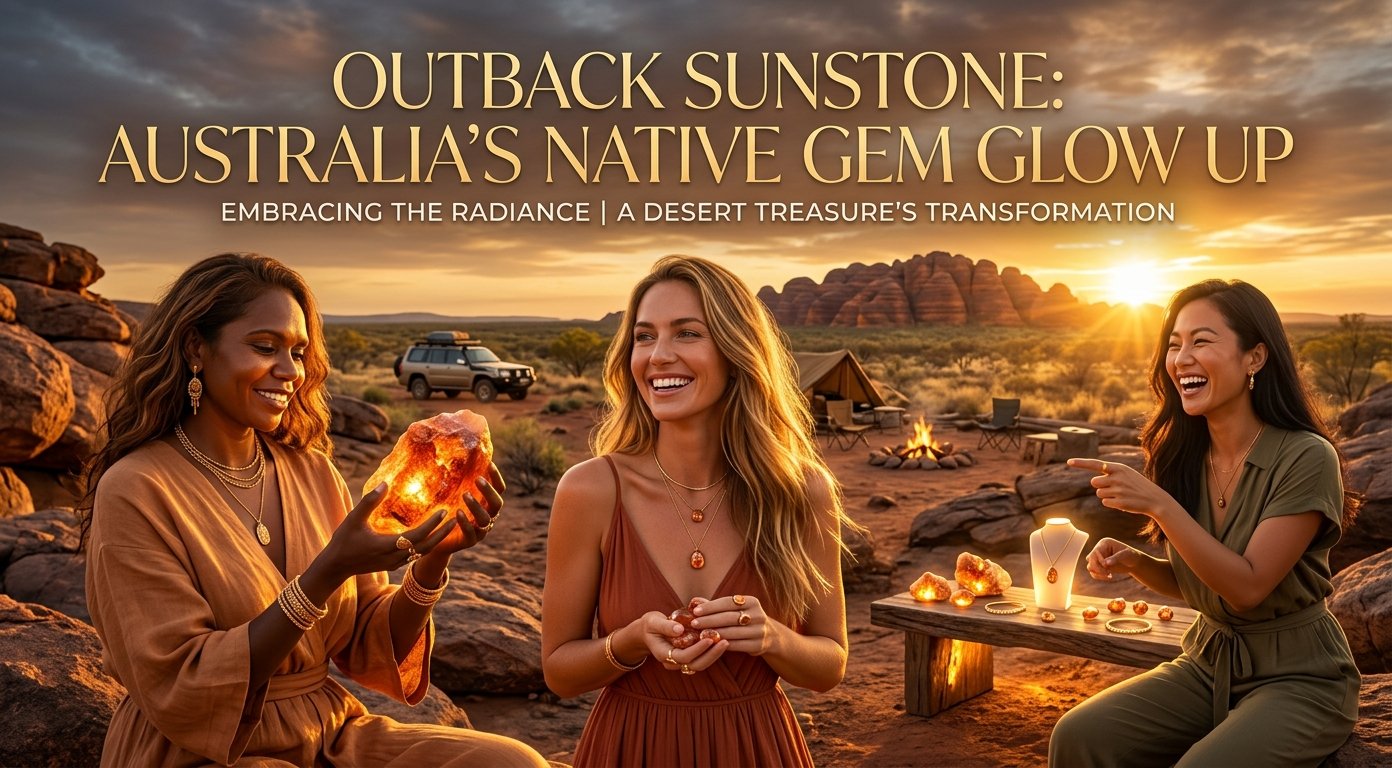
Unearth the raw, untamed beauty of the Australian desert captured inside a single, luminous gemstone. Born in the rugged heart of the Australian Outback, the Outback Sunstone is taking the fine jewelry world by storm. Known for its mesmerizing play of light, warm golden body tones, and sun-kissed copper inclusions, this native treasure has officially received its ultimate “Gem Glow Up“—blending millions of years of natural geological history with master-level precision faceting and contemporary fine jewelry aesthetics.
Whether you are an avid gemstone collector, a fine jewelry artisan, or someone searching for an extraordinary engagement ring alternative with a deep, authentic connection to the Earth, the Outback Sunstone offers an irresistible combination of warmth, rarity, and radiant Australian fire.
The Outback Sunstone belongs to the feldspar mineral family, sharing a structural lineage with other famous optical gemstones such as moonstone, labradorite, and amazonite. However, what sets Australia’s native sunstone completely apart from other global feldspar deposits is its extraordinary clarity combined with distinct, metallic copper inclusions embedded inside the crystal lattice.
When ambient light enters the stone and hits these microscopic copper platelets, it triggers an optical phenomenon known as schiller (or aventurescence). This effect creates a fiery, golden-orange metallic sparkle that appears to dance and glow directly from within the center of the gem.
Sourced directly from remote, sun-baked Australian gem fields, each Outback Sunstone tells a story of intense heat, extreme pressure, and ancient volcanic activity. The natural color spectrum of these stones is breathtakingly broad, ranging from delicate champagne and blushing peach to deep terracotta, fiery cinnamon, and intense reddish-gold hues.
Australia has long been recognized worldwide as the primary capital for fine opals, sapphires, and rare colored diamonds. For generations, however, the humble Australian sunstone remained a well-kept secret among regional bush cutters, fossickers, and local lapidaries. Today, as global collectors actively seek out unique, non-traditional colored gemstones, the Outback Sunstone is stepping squarely into the global spotlight.
Every genuine Outback Sunstone is extracted from small-scale, environmentally conscious mining operations located in remote desert regions across Australia. Unlike large industrial diamond or gold operations, these small-scale mines prioritize land preservation, responsible water usage, and complete supply chain transparency from bush to bench.
The signature hallmark of the Outback Sunstone is its natural “schiller.” Depending on the size, orientation, and concentration of internal copper platelets, the optical phenomenon can appear as a soft, hazy liquid-gold shimmer or as a dramatic explosion of sharp, metallic orange and red pin-fire flashes when viewed under direct sunlight.
In an industry where heat treatments, irradiation, fracture filling, and surface diffusions are commonplace, the Outback Sunstone stands out for its absolute purity. These gems are 100% natural, unheated, and untreated. The fiery colors and metallic copper sparkles you observe were forged entirely by nature.
Compared to sunstone deposits found in other parts of the world, Australian sunstones frequently exhibit high internal clarity alongside their inclusion patterns. This high clarity allows light to travel deeper into the gem, reflecting off internal facets and maximizing total light return.
The phrase “Gem Glow Up” isn’t just about rising popularity—it reflects a total revolution in how the Outback Sunstone is cut, faceted, shaped, and set into high jewelry.
Historically, opaque or heavily included sunstones were smoothed into simple round or oval cabochons (polished domes). While cabochons display schiller well, they do not produce brilliance or prismatic scintillation.
The modern “glow up” began when world-class master lapidaries started applying high-precision, computer-modeled faceting techniques to gem-grade rough material. Today, you will find Outback Sunstones cut into magnificent geometric silhouettes:
Precision Cushion Cuts: Maximizes color concentration while allowing schiller to cluster brilliantly in the center.
Radiant & Oval Cut Prisms: Engineered with calculated pavilion angles that bounce light back through the copper platelets for maximum fire.
Shield & Hexagon Cuts: Modern, edgy shapes popular in contemporary bohemian and alternative engagement rings.
Sunburst Cuts: Feature intricate underside star faceting that mirrors rays of light radiating outward from the center.
Jewelry designers across Australia, North America, and Europe are pairing the Outback Sunstone with luxury metals and accent gemstones. Moving beyond traditional silver or basic gold wire wraps, the Outback Sunstone is now featured in solid 18k gold, platinum, and rose gold settings accented with brilliant white diamonds, champagne diamonds, and pastel sapphires.
To help you assess the physical properties, quality metrics, and gemological characteristics of the Outback Sunstone, review the detailed technical profile below:
Chemical Composition: Sodium Calcium Aluminum Silicate (Na,Ca)(Si,Al)3O8
Mineral Species: Plagioclase Feldspar (Oligoclase to Andesine series)
Origin: Remote Outback Mining Regions, Australia
Color Range: Champagne, Pale Peach, Salmon, Warm Cinnamon, Deep Terracotta, Reddish-Gold
Optical Phenomenon: Aventurescence (Copper Schiller / Sparkle Effect)
Refractive Index (RI): 1.532 – 1.552
Specific Gravity: 2.62 – 2.67
Mohs Hardness: 6.0 – 6.5
Toughness: Fair to Good (Features perfect cleavage in two directions)
Enhancements / Treatments: None (100% Natural, Unheated)
Clarity Grades: VVS (Eye Clean) to Moderately Included (Inclusions contain copper schiller)
Ideal Metals: 14k/18k Rose Gold, 18k Yellow Gold, 950 Platinum, Fine Sterling Silver
Not all Outback Sunstones look the same. Depending on the exact geological pocket where the rough crystal was formed, stones exhibit varying combinations of body color and optical effects.
Featuring a clear to pale golden body color, these stones display delicate, light-reflecting copper flakes. In lower light, they appear like elegant champagne topazes, but under direct light, they explode into a soft golden-orange shimmer.
These are among the most sought-after collector pieces. They possess a rich, deep reddish-orange body tone saturated with dense clusters of micro-copper platelets. The result is an intense, fiery glow that resembles liquid lava trapped inside crystal glass.
In exceptionally rare geological formations, Outback Sunstones display dichroic properties, showing subtle shifts between warm orange-red and cooler greenish-amber tones when viewed from different crystallographic axes. These rare gems are reserved for high-end bespoke jewelry pieces.
The warm, earthy palette of the Outback Sunstone allows it to complement a wide array of skin tones and metal choices. Here is how top jewelry designers are styling this native Australian gem:
14k or 18k Rose Gold: Rose gold is the ultimate companion for the Outback Sunstone. The warm copper tones in the metal highlight the internal copper schiller, creating a harmonious, romantic monochrome aesthetic.
18k Yellow Gold: Yellow gold heightens the warm orange, terracotta, and golden undertones of the stone, giving the finished jewelry piece an opulent, sun-drenched appearance.
950 Platinum or White Gold: Crisp white metals create an eye-catching contrast. The icy, reflective background of platinum makes the warm, fiery center of the sunstone pop with intense color clarity.
Alternative Engagement Rings: Set a precision cushion or oval Outback Sunstone into a classic 4-prong setting with a hidden diamond halo for an eco-friendly, distinct alternative to traditional diamonds.
Sunburst Pendant Necklaces: Frame a round or shield-cut sunstone with radiating gold rays or small brilliant-cut diamonds to emulate the blazing Outback sun.
Drop & Dangle Earrings: Earrings move constantly as you walk, allowing natural light to strike the gem from multiple angles and activating the dramatic internal schiller effect continuous throughout the day.
Statement Solitaire Rings: Showcase a large carats-weight terracotta sunstone in a thick, protective bezel setting for a sleek, contemporary unisex design.
While sunstones are mined in a few other locations globally, Australia’s native sunstone holds distinct advantages in clarity, color saturation, and provenance:
Primary Inclusion Type: Australian Outback Sunstones contain native microscopic copper platelets, similar to Oregon Sunstones, whereas Indian and Tanzanian varieties typically rely on hematite or goethite flakes.
Body Color Range: Australian gems offer champagne, peach, terracotta, and red-gold tones. By contrast, Oregon stones span green, red, and bi-color shades, while commercial Indian deposits lean toward opaque brown and orange-gray hues.
Clarity & Optical Intensity: Australian sunstones feature high eye-clean clarity paired with a fine, uniform internal glow. Indian and Tanzanian options tend to be opaque with spotty metallic flakes.
Rarity: Australian Outback Sunstones are extremely rare and sourced from limited small-scale mines, making them highly prized for provenance compared to high-abundance commercial material.
With a Mohs hardness rating of 6.0 to 6.5, the Outback Sunstone is durable enough for daily wear in necklaces, earrings, and low-impact rings. However, like all natural feldspar gemstones, proper care ensures your gemstone maintains its mirror-like polish and fire for generations.
Soap & Water: Clean your sunstone using warm water, mild liquid dish soap, and a soft-bristled toothbrush. Gently brush behind the setting where dust and skin oils collect.
Rinse & Dry: Rinse thoroughly under clean warm water and pat dry with a soft microfiber cloth.
No Ultrasonic or Steam Cleaners: High-frequency ultrasonic vibrations and sudden steam heat can expand internal microscopic cleavage planes or copper inclusions, potentially compromising the stone’s integrity.
Avoid Harsh Chemicals: Always remove sunstone jewelry before swimming in chlorinated pools, using household cleaning agents, or applying hairsprays and perfume.
Safe Storage: Store your Outback Sunstone in a soft fabric-lined jewelry box away from harder gemstones like sapphires, rubies, and diamonds to prevent surface scratching.
“A Pure Piece of Australian Magic!”
“I purchased an 1.8-carat oval Outback Sunstone set in rose gold for our 10th anniversary. Indoors, it has this elegant peach glow, but as soon as you step outside into the sunlight, it literally ignites. It looks like liquid gold and copper swirling inside the stone. Photos don’t do it justice!”— Evelyn R., Sydney, Australia
“The Perfect Alternative Engagement Ring”
“My fiancée wanted a gemstone that was ethically mined, unique, and native to Australia. Our jeweler sourced a gorgeous shield-cut terracotta Outback Sunstone. The clarity is astounding, and the subtle copper sparkle is unlike anything else.”— Marcus & Chloe T., Melbourne, Australia
“Incredible Material for Lapidary Work”
“As a custom gem cutter, cutting Australian sunstone rough is an absolute dream. The material cuts clean, takes an exceptionally bright polish, and the internal copper schiller makes every finished gem one-of-a-kind.”— Julian K., Master Lapidary
Yes. The Outback Sunstone is a 100% natural plagioclase feldspar gemstone mined directly from natural rock formations in Australia. It is entirely unheated, untreated, and unenhanced.
The sparkle is caused by a natural optical phenomenon called aventurescence (or schiller). As the crystal formed over millions of years, tiny microscopic platelets of native copper were trapped inside. Light reflecting off these internal copper flakes creates a fiery metallic glow.
Yes, provided you take proper care. With a Mohs hardness of 6.0–6.5, it is suitable for everyday wear. For daily rings, we recommend choosing protective setting styles such as bezels, flush mounts, or robust multi-prong settings.
All genuine Outback Sunstones are extracted from small-scale Australian mines operating under strict Australian environmental regulations and fair labor practices, guaranteeing eco-conscious sourcing from mine to market.
Bring home the warmth, ancient geological history, and brilliant fire of Australia’s most captivating native gem. Explore our curated inventory of loose, precision-faceted Outback Sunstones or start your custom fine jewelry project today.


© 2026 Gemglowup-au.com | All Rights Reserved