For decades, the global gemstone industry operated under an unyielding rule: absolute monochromatic purity. A blue sapphire was expected to recall the deep velvet skies of Kashmir; a ruby, the vivid red of pigeon’s blood; an emerald, the lush green of Colombian fields. Any internal variation, trace band of secondary hue, or structural color separation was routinely dismissed by traditional gemologists as an undesirable inclusion or geological defect. Stones carrying split personalities were systematically cut away, discarded, or relegated to bottom-tier commercial parcels.
Australia’s ancient geological landscape, however, was quietly holding a radically different masterpiece. Deep beneath the weathered basalt fields of Central Queensland and the misty high-country gemfields of New England, New South Wales, volcanic forces tens of millions of years ago forged corundum crystals that flatly rejected single-tone conformity. These crystals encapsulated bold, unblended bands of bright lemon-yellow, deep sapphire-blue, and vivid eucalyptus-green trapped side-by-side inside a single atomic structure.
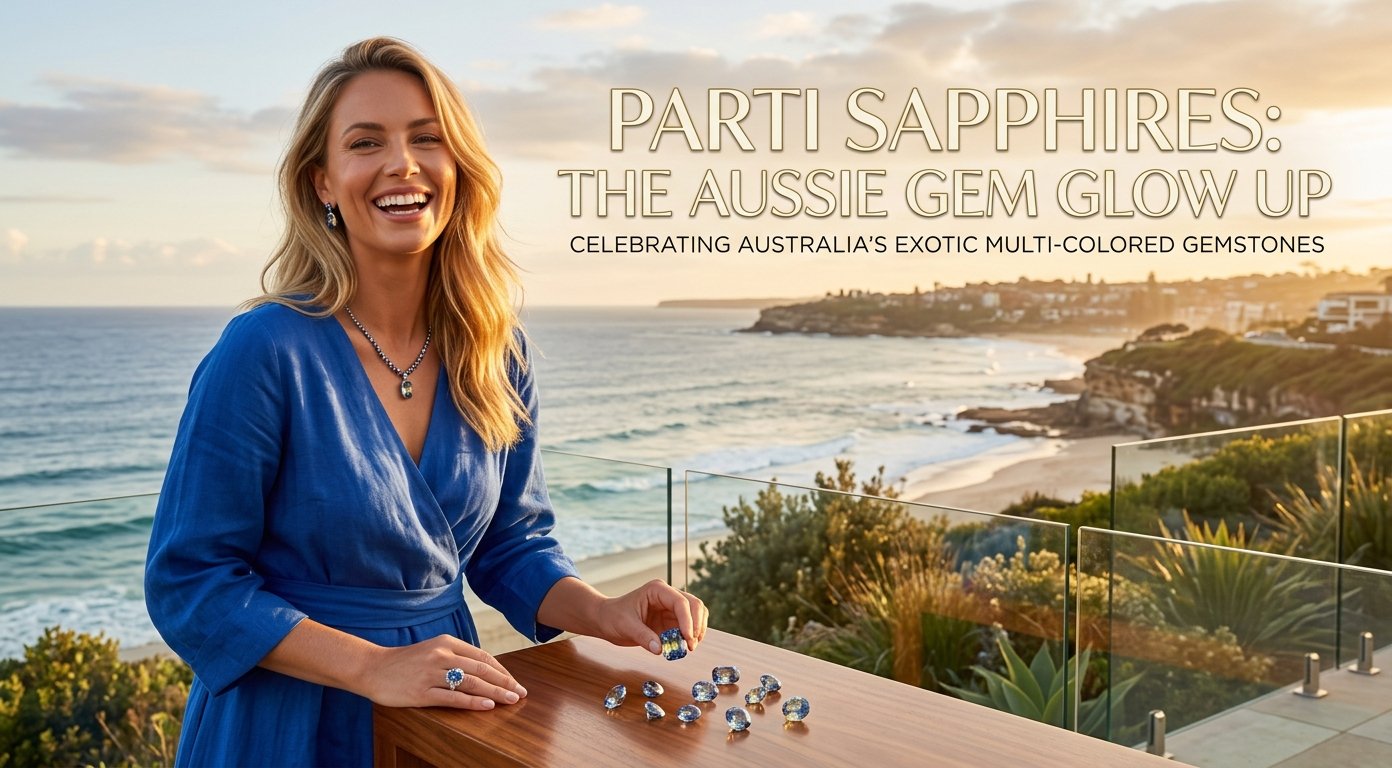
Known across the trade as Parti Sapphires (derived from the word partitioned), these multi-hued treasures were once overlooked by legacy luxury houses obsessed with uniformity. Today, they sit at the absolute epicenter of a global jewelry revolution—a genuine Gem Glow Up. Driven by a cultural pivot toward individuality, ethical transparency, and artisanal storytelling, Australian Parti sapphires have transformed from obscure local curiosities into the most sought-after centerpieces for bespoke jewelry and non-traditional engagement rings across Australia and beyond.
A Parti sapphire is a natural corundum gemstone displaying two or more distinct, clearly defined color zones within a single stone. It is critical to distinguish a true Parti sapphire from a bi-color or teal sapphire. While bi-color or teal gems feature trace minerals that blend homogeneously to create a single secondary shade (such as blue-green or ocean-teal), a Parti sapphire preserves hard-edged, unblended boundaries.
When looking down through the table facet of a premium Australian Parti sapphire, you do not merely see a mixed teal hue; you see an unmistakable ribbon of sunshine yellow laid adjacent to a deep, brooding cobalt blue, bordered by a slice of pine green.
The distinct personality of Australian Parti sapphires is a direct reflection of the continent’s dynamic geological history:
Basaltic Volcanic Transport: Australian sapphires are sub-continental in origin, crystallizing deep within the lower crust or upper mantle. During the Cenozoic era (roughly 15 to 45 million years ago), explosive alkali basalt volcanic eruptions ripped through these deep reservoirs, acting as rapid elevators that propelled the sapphires upward to the surface.
Chemical Environment Shifts: As the corundum crystal was growing over thousands of years, the chemical composition of the surrounding magma fluctuated wildly. The introduction of pure iron created brilliant yellow and golden tones. When both iron and titanium were introduced simultaneously, light absorption shifted to yield deep royal blue.
Sharp Zonal Freezing: Because these volcanic eruptions were violently fast and the cooling ambient conditions changed rapidly, the trace element changes were frozen instantly into the crystal lattice. Rather than bleeding together, the chemical boundaries remained distinct, creating permanent color partitions.
No two natural Parti sapphires are identical. Every polished gem offers a distinct footprint shaped by its original rough geometry, internal color distribution, and the precision of the lapidary cutter who brought it to life.
Color Partitioning: Features sharp, unblended bands, streaks, or geometric blocks of yellow, blue, and green. High visual contrast between adjacent color zones dramatically elevates market value.
Mohs Hardness: Measures 9 out of 10 on the Mohs scale, sitting second only to diamond in scratch resistance. This exceptional durability makes them perfect for lifetime daily wear in engagement rings.
Refractive Index: Ranges from 1.762 to 1.770, offering high optical density and light manipulation. It requires precise facet angles to prevent internal light bleeding across color boundaries.
Ethical Sourcing: Mined primarily in Queensland’s Central Gemfields (Anakie, Rubyvale) and New South Wales (Inverell). They offer a fully traceable origin back to low-impact, regulated Australian mining operations.
Pleochroism: Exhibits strong directional pleochroism showing different colors when viewed from different angles. This enhances dynamic movement, making the stone appear to change palette as the wearer moves their hand.
While every Parti sapphire is a unique piece of natural art, several iconic color profiles have defined the Australian gem glow up:
Widely considered the ultimate prize of the Queensland gemfields, the Classic Tri-Color features three starkly separated zones: sunny canary yellow, fresh grass green, and dark sapphire blue. When light enters the faceted crown, it hits multiple color zones simultaneously, throwing off multi-hued spectral flashes.
Taking its name from Australia’s national floral emblem—the Golden Wattle—this profile abandons heavy blue tones entirely. Instead, it displays a pairing of vibrant honey-yellow and earthy eucalyptus-green. The result is a warm, organic aesthetic that feels deeply connected to the Australian bushland.
An extraordinary geometric rarity occurs when a core of pure yellow corundum is completely encircled by a secondary growth layer of dark blue or teal sapphire. When oriented correctly by a master cutter, the finished stone displays a striking yellow central iris surrounded by a blue ring.
In these stones, the volcanic chemical shifts occurred in rapid succession, resulting in parallel, razor-thin bands of blue and yellow alternating through the crystal like physical stripes. This creates visual depth that makes the interior of the stone appear three-dimensional.
The dramatic rise of the Australian Parti sapphire is not an accident; it is the direct outcome of a massive cultural shift in how luxury items are defined and consumed by modern buyers.
In a world saturated with laboratory-grown diamonds, mass-produced synthetic gems, and identical commercial cuts, true luxury has pivoted back to unrepeatability. A lab can grow a perfectly flawless white diamond or a uniform blue sapphire on demand. However, a laboratory cannot replicate the spontaneous, chaotic volcanic dynamics required to forge a high-contrast Parti sapphire. Owning a Parti sapphire guarantees that no other person on Earth will ever wear an identical stone.
For contemporary couples seeking unique engagement rings, traditional single-tone stones can feel impersonal. The Parti sapphire offers a romantic metaphor: two distinctly different hues—representing two distinct individuals with their own personalities—coexisting within a single, unbreakable crystal.
Modern jewelry buyers care as much about the journey of a gemstone as its final appearance. Australia enforces some of the world’s strictest environmental restoration standards, water conservation rules, and labor protections in the mining sector. Australian gemfields are predominantly worked by small-scale, family-run operations or independent mechanised miners who treat the land with immense respect. Every Australian Parti sapphire carries a clean, conflict-free history.
Cutting a standard blue sapphire is a straightforward task: the lapidary aligns the optical axis of the rough crystal directly perpendicular to the table facet to yield the deepest, most uniform blue shade possible.
Cutting a rough Australian Parti sapphire, however, requires the strategic eye of a master sculptor. If a factory cutter approaches a Parti rough with standard commercial techniques, the blue and yellow zones will mix inside the stone, turning the light refraction into a dull, muddy olive-brown.
Mapping Internal Boundaries: The cutter submerges the rough crystal in heavy liquid (like refractive oil) and uses cross-polarized light to map the exact internal spatial layout of the iron and titanium pockets.
Choosing the Geometry: Step cuts (like emerald and baguette shapes) and modified radiant cuts are often preferred over round brilliant cuts. The flat, open facets of step cuts preserve clear visual divisions, preventing colors from washing each other out.
Table Alignment: The table facet must be oriented strictly parallel or perpendicular to the primary color planes. By aligning the table directly over a yellow-blue junction, both hues bounce light back to the eye independently, maintaining their distinct identity.
Because Australian Parti sapphires contain both warm (yellow) and cool (blue/green) internal color signatures, they are uniquely adaptable across various precious metals:
18k Yellow Gold: Warm yellow gold settings draw out the internal canary and golden bands of a Parti stone. The yellow prongs act as optical pipes, bouncing warm light into the gem and highlighting its lighter zones.
Platinum & White Gold: Ideal for high-contrast presentation. White metals cool down the setting, allowing dark royal blue and deep teal bands to stand out sharply against the golden pockets.
18k Rose Gold: Provides a soft, romantic contrast, particularly when paired with “Wattle” profile stones rich in eucalyptus green and soft champagne yellow.
Australian Parti sapphires possess a hardness rating of 9 on the Mohs scale, combined with excellent toughness due to their dense, crystalline atomic layout. They do not feature the internal cleavage planes that make diamonds vulnerable to splitting upon hard impact, making them exceptionally durable for daily life.
To maintain the maximum optical brilliance of your stone:
Routine Cleaning: Soak the ring in a dish of warm water mixed with a few drops of mild dishwashing liquid for 15 minutes. Gently scrub behind the setting using a soft-bristled baby toothbrush to clear away skin oils, soap residue, and lotion buildup.
Chemical Exposure: While sapphires are resistant to most household chemicals, avoid exposure to harsh industrial acids or concentrated chlorine bleach during swimming, as these can degrade gold and platinum setting prongs over time.
Ultrasonic Cleaning: Natural, untreated Australian Parti sapphires without heavy surface-reaching fractures are completely safe for ultrasonic and steam cleaning systems.
Yes. Genuine Australian Parti sapphires derive their multi-colored zoning entirely from natural geological processes. The iron and titanium trace element distributions were formed naturally millions of years ago in volcanic basalt flows.
Historically, uniform blue sapphires commanded higher commercial market prices. However, over the past decade, high-quality Australian Parti sapphires featuring clean clarity, crisp color boundaries, and expert custom cuts have appreciated dramatically, frequently matching or exceeding single-tone stones in the boutique market.
Many Australian Parti sapphires are completely unheated, as their natural yellow and blue color zones are already striking straight out of the ground. When mild heat treatment is applied, it is done solely to improve internal clarity by dissolving silk (microscopic rutile needles) without altering the natural color boundaries.
The story of the Australian Parti sapphire is a testament to nature’s unpredictable artistry. Once cast aside for not fitting into a rigid mold, this extraordinary gemstone has rightfully claimed its place at the top of modern jewelry design. By combining high-contrast natural beauty, unmatched physical durability, and a clean ethical origin, the Aussie Parti sapphire stands as the ultimate expression of individual style—a true gem glow up that will sparkle for generations.


© 2026 Gemglowup-au.com | All Rights Reserved