Unearthing an exceptional gemstone is a thrill like no other. Whether you are hunting for the deep, oceanic blue of a classic sapphire or the dazzling, spectral flash of an Australian opal, securing an authentic treasure is paramount. As gem synthesis and enhancement technologies become more sophisticated, distinguishing natural, earth-mined gems from lab-grown counterparts, clever imitations, and assembled composite stones requires a trained eye, systematic evaluation, and reliable analytical techniques. At Gem Glow Up, we empower collectors, jewelers, and everyday enthusiasts across Australia with the knowledge, professional verification, and specialized care needed to buy, identify, and maintain high-value gemstones with absolute confidence.
Sapphires belong to the corundum mineral family, composed primarily of aluminum oxide (Al2 O3). In its purest form, corundum is completely colorless. The breathtaking array of colors observed in sapphires results from trace chemical elements entering the crystal lattice during growth under intense heat and pressure deep within the Earth’s crust.
When trace amounts of iron (Fe2+) and titanium (Ti4+) interact within the corundum lattice through charge transfer, they produce the legendary deep blue hues prized worldwide. When chromium (Cr3+) is present, the crystal turns pink or red (classified as ruby), while combinations of iron and vanadium yield yellow, green, and orange varieties.
Because laboratory-grown sapphires possess the exact same chemical composition, trigonal crystal structure, and physical properties as mined sapphires—including a rating of 9 on the Mohs hardness scale—they cannot be identified by simple scratch tests, basic thermal probes, or visual inspection with the naked eye alone. Identification relies entirely on examining internal inclusions, growth structures, and trace element distribution under magnification.
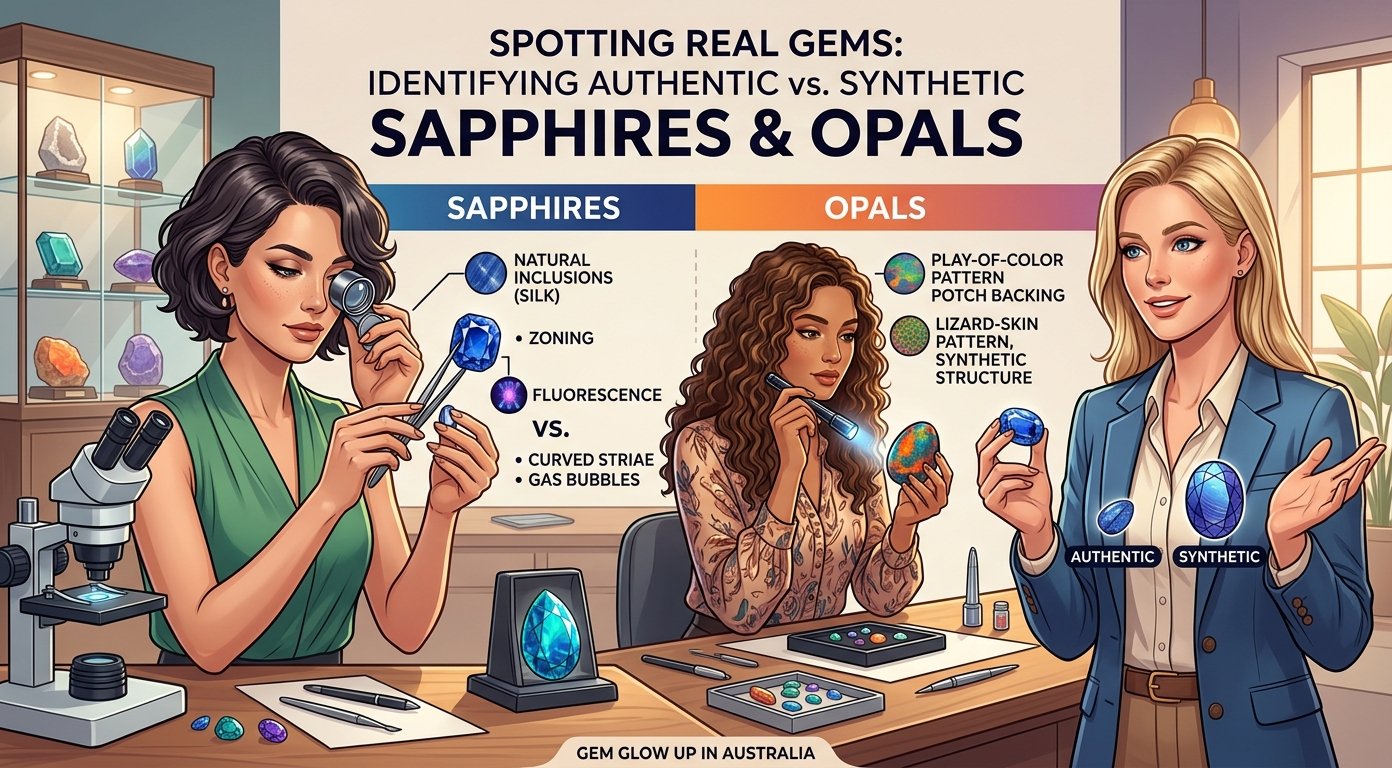
Microscopic Inclusions & “Silk”: Mined sapphires almost universally carry tiny internal characteristics formed over millions of years. Look for ultra-fine, intersecting needles of rutile ($\text{TiO}_2$), commonly referred to as “silk.” Under magnification, authentic silk intersects at precise $60^\circ$ and $120^\circ$ angles, mirroring the hexagonal symmetry of the corundum crystal.
Angular Color Zoning: Natural sapphires routinely exhibit straight, angular color bands or color zones that mirror the outer geometric growth faces of the original rough crystal.
Crystalline Inclusions: Intact secondary mineral crystals—such as zircon halos, mica flakes, spinels, or tiny garnet pockets—serve as definitive signatures of earth-mined origin.
Lab-created sapphires typically fall into two primary manufacturing categories: Flame Fusion (Verneuil Method) and Flux or Hydrothermal Growth.
Flame Fusion Inclusions: Flame fusion is the most common and cost-effective synthetic technique. Because molten alumina powder drops through a high-temperature torch and cools rapidly while rotating, the synthetic crystal forms in a rounded boule. As a result, cut gems feature distinct curved growth lines (striae) and tiny, spherical gas bubbles trapped inside.
Flux Growth Inclusions: Flux-grown synthetics grow far more slowly in a molten solution, closely mimicking natural conditions. However, they exhibit characteristic “flux fingerprints”—veil-like patterns that resemble liquid trapped in fine fractures—as well as metallic platinum flakes detached from the crucibles used during synthesis.
Unrealistic Perfection: Synthetic sapphires often look suspiciously flawless. If a substantial blue sapphire displays eye-clean clarity, hyper-uniform color distribution, and a complete absence of internal structural features at an unusually affordable price, it is overwhelmingly likely to be synthetic.
Australia is the world’s premier source of precious opal, producing over 90% of the global commercial supply. From the midnight-dark body tones of Lightning Ridge black opals to the vibrant play-of-color in Coober Pedy white opals and Queensland boulder opals, these gems hold a cherished position in Australian cultural heritage and gemology.
Unlike crystalline sapphires, opal is an amorphous hydrated silicon dioxide (SiO2 . nH2O) containing between 3% and 21% water by weight (typically 6% to 10% in precious gem material). The structure consists of sub-microscopic spheres of silica packed together in orderly, three-dimensional grids. The size and uniform spacing of these spheres diffract light traveling through the stone, splitting white light into vibrant spectral colors—a phenomenon uniquely known as play-of-color.
Because top-grade Australian opal commands substantial value per carat, the marketplace contains synthetic opals (such as Gilson synthetic opal), glass or plastic imitations (Slocum stone), and manufactured composite assembled stones designed to replicate the appearance of solid black opal.
Solid Natural Opal: Formed entirely of natural precious opal, presenting a uniform stone throughout both the face and back. Key identification markers include irregular, organic color patches, natural potch backing, and a unique, non-repeating color flash across the surface.
Synthetic (Gilson) Opal: A laboratory-grown silica sphere matrix engineered with artificially uniform sphere packing. Key identification markers include a distinct “lizard-skin” or honeycomb pattern under $10\times$ magnification, along with overly regular, vertical column structures when viewed from the side.
Doublet: A manufactured composite stone made of a thin slice of natural precious opal bonded with dark epoxy to a black backing layer (typically black potch or ironstone). The primary identification marker is a perfectly flat, razor-sharp join line visible running along the side profile.
Triplet: An assembled composite consisting of a thin opal slice capped with a transparent quartz or glass dome and glued to a dark backing base. Key identification markers include a glassy, exaggerated dome that separates from the color flash underneath, distinct dual join lines, and a susceptibility to fogging if submerged in water.
Inspect the Side Profile (Unmounted Stones): Always view an unmounted opal sideways under adequate lighting. A solid opal exhibits continuous, uninterrupted structure and potch throughout. A doublet displays a flat, razor-sharp line of junction where the thin opal top meets the dark backing. A triplet reveals three distinct stacked layers: a transparent cap, a paper-thin opal center, and a thick base.
Evaluate Mounted Jewelry: When opals are set into closed-back jewelry settings that conceal the sides, inspect the top surface carefully. Triplet caps are fabricated from clear quartz, spinels, or glass, creating a high-gloss, magnifying effect that appears distinctly separated from the flash pattern underneath. Looking at the stone from an oblique angle reveals the flat slice sitting beneath a curved transparent dome.
Recognize Synthetic Patterns: Synthetic opals exhibit highly ordered internal geometry. Under 10 times magnification, the color patches in Gilson synthetic opals display a distinct honeycomb or “lizard-skin” texture. Furthermore, when viewed from the side, the color patches form long, straight vertical columns, contrasting sharply with the chaotic, cloud-like distribution of natural gems.
While comprehensive gemological testing requires specialized laboratory instrumentation, collectors, antique shoppers, and market buyers can employ several reliable non-destructive field checks when evaluating pieces in the field.
10 times Triplet Jeweler’s Loupe: The single most crucial tool for inspecting internal gemstone characteristics. A triplet lens corrects chromatic and spherical distortion.
Focused LED Penlight: Essential for transmitted lighting, side illumination, and backlight testing.
Microfiber Cleaning Cloth: Removes surface fingerprints, skin oils, and dust before evaluation.
Clean the Gemstone Thoroughly: Wipe the stone down completely. Surface oils, dust, and fingerprints regularly mimic internal haze or inclusions under magnification.
Examine Internal Structure Under Strong Diffused Light: Direct light through the side of a sapphire while viewing from the top through your 10X loupe.
Straight, sharp-angled color bands intersecting at 60 degree or 120 degree Indicates Natural Origin.
Softly curved, parallel lines running across the gem? Indicates Flame Fusion Synthetic.
Assess Pattern Geometry in Opals: Slowly rotate the opal under a single light source.
Do color flashes shift organically in broad, irregular patches across the surface? Indicates Natural Precious Opal.
Do color patches resemble neat, perfectly uniform mosaic squares or repeating honeycomb patterns? Indicates Synthetic Opal.
Inspect Setting Metal Quality: High-value natural sapphires and solid Australian opals are rarely set into cheap base metals. Look for official precious metal hallmarks (e.g., .750, 18K, Pt950, 925) stamped inside rings or on pendant bails.
Field checks provide excellent preliminary clues, but definitive identification often requires specialized laboratory equipment—including refractometers to measure refractive index (RI), polariscopes to evaluate optic character, hydrostatic balances for specific gravity, immersion cells, and shortwave/longwave ultraviolet fluorescence units.
At Gem Glow Up, we bridge the gap between field collecting and complete peace of mind for gemstone lovers throughout Australia.
Comprehensive Gem Identification & Origin Audits: In-depth evaluation using binocular gemological microscopes and refractometry to distinguish natural gems from synthetics, doublets, triplets, and glass imitations.
Treatment Identification: Advanced screening to detect common treatments, such as high-temperature heat treatment, beryllium diffusion, surface-reaching fracture filling, and color dye treatments.
Opal Structural Assessment: Precise identification of solid, doublet, triplet, or synthetic opal material, ensuring you pay fair market value when acquiring or insuring items.
Professional Restoration & Cleaning: Cleaning regimens tailored specifically to sensitive gem materials. While hard sapphires handle standard ultrasonic cleaning effortlessly, hydrated opals require delicate hand care, thermal shock protection, and balanced hydration preservation to prevent crazing or structural damage.
Pre-Purchase Advisory: Considering an estate sapphire piece or an Australian black opal? Consult our specialists for an objective, impartial appraisal before completing your investment.
The world of fine gemstones is filled with remarkable history, fascinating chemistry, and unmatched natural beauty. By mastering the fundamentals of gemstone structure, knowing what to look for through a 10 times loupe, and partnering with experienced Australian gemological experts, you can build and preserve a stunning collection that maintains both its aesthetic brilliance and long-term financial value.
Whether you need a vintage sapphire ring evaluated, an Australian opal inspected for authenticity, or professional restoration guidance, Gem Glow Up is here to ensure your treasures shine with absolute confidence.


© 2026 Gemglowup-au.com | All Rights Reserved