
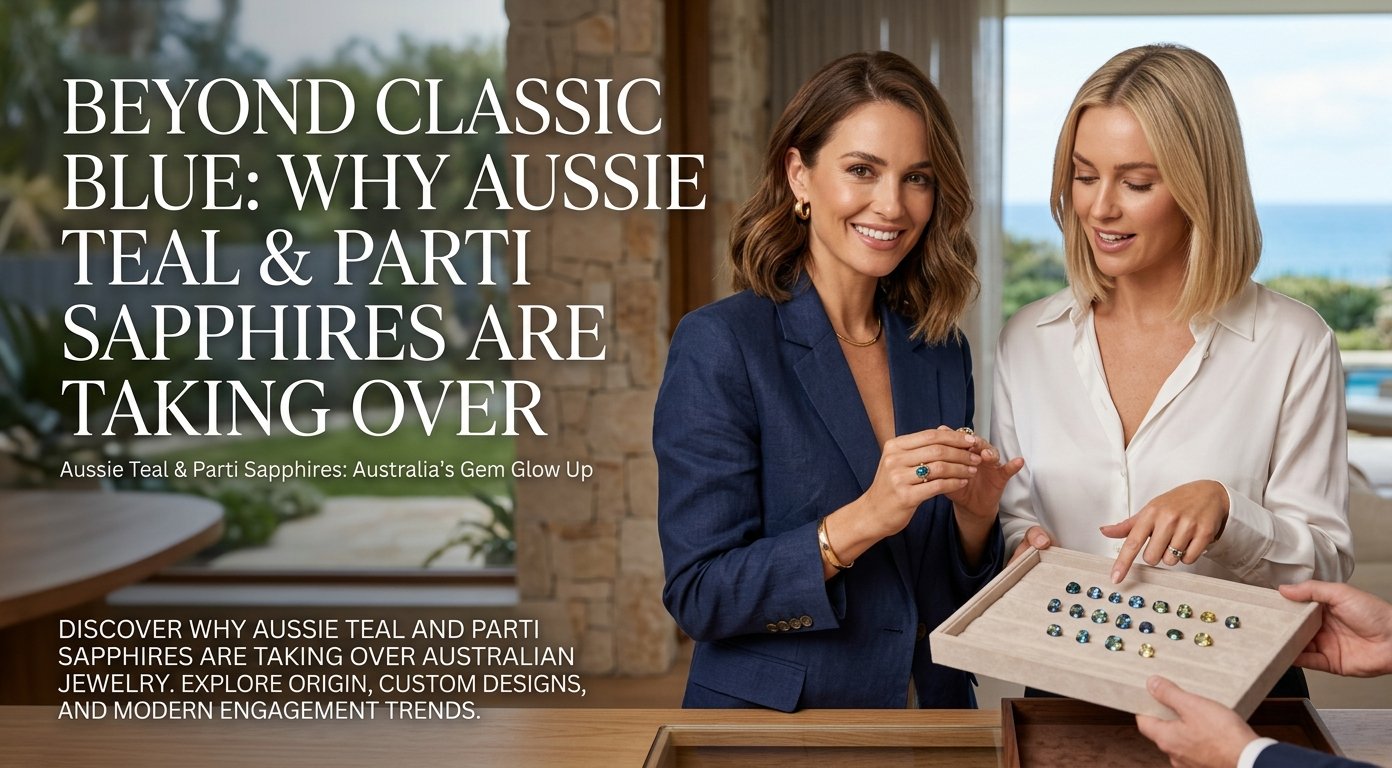
For generations, the definition of a fine sapphire in Australia was simple, strict, and overwhelmingly uniform: a deep, velvety royal blue or a dark navy, cut into a traditional oval and framed by a halo of brilliant white diamonds. While classic blue sapphires will always retain a place in high jewelry, a massive shift has reshaped the Australian luxury landscape. Modern jewelry wearers are actively turning away from mass-market uniformity in favor of stones that possess distinct personality, organic color variations, and a direct link to the earth beneath their feet.
At the absolute center of this movement are two extraordinary native gemstones: the Australian teal sapphire and the vibrant Australian parti sapphire. Once overlooked by traditional gem dealers who favored single-color saturation, these multi-hued treasures are now the most sought-after centerpieces for contemporary engagement rings, heirloom redesigns, and high-end custom pieces across the country. Together with the growing movement known as the “Gem Glow Up“—where clients repurpose, restyle, and reimagine raw stones or inherited settings into modern masterpieces—Aussie teal and parti sapphires have transformed from local geological wonders into global design icons.
To appreciate the rise of these stones, one must first understand what makes them so fundamentally different from traditional sapphires sourced elsewhere in the world. While classic sapphires display a single, solid hue throughout the crystal, teal and parti sapphires are celebrated precisely for their rich internal complexity and dynamic visual shifts.
Teal sapphires occupy a mesmerizing middle ground between blue and green. Rather than showing a muddy or muted mix, a high-grade Australian teal sapphire contains distinct blue and green primary wavelengths, often laced with delicate undertones of yellow, mint, or sage.
What makes teal sapphires so captivating is their optical behavior. Under natural daylight, an Australian teal sapphire tends to radiate bright, cheerful oceanic hues reminiscent of the Ningaloo Reef or Queensland coast. Bring the same stone indoors under warm incandescent lighting, and it shifts dramatically toward deep evergreen, deep spruce, or moody midnight teal. This natural color-shifting quality ensures that the gem never looks the same twice in a single day, giving the wearer an ever-evolving piece of art on their hand.
If teal sapphires are defined by their smooth blending of color, parti sapphires are defined by their striking separation. The term “parti” refers to color-zoning—a phenomenon where two or more distinct, unmixed color bands exist within the very same crystal structure.
In Australian parti sapphires, these zones typically feature sharp, vivid intersections of sky blue, deep green, and bright canary yellow. Because these color bands formed over hundreds of millions of years in response to fluctuating mineral environments deep underground, no two parti sapphires will ever feature the exact same color distribution or geometry. When a lapidary artist cuts a raw parti crystal, they carefully orient the facets to maximize the way light passes through these distinct color zones. The result is a kaleidoscopic explosion of flash and contrast, where yellow flashes shoot through deep green body tones and bright blue reflections ignite the stone from within.
The unique visual magic of Australian teal and parti sapphires is a direct byproduct of the country’s intense geological history. Australia’s primary sapphire fields—located predominantly in the Central Queensland Gemfields (around Rubyvale, Sapphire, and Emerald) and the New England region of New South Wales (around Glen Innes and Inverell)—were forged by explosive volcanic activity that occurred between 19 million and 35 million years ago.
During these ancient eruptions, sapphire crystals were carried upward from deep within the Earth’s mantle inside basaltic lava flows. As the magma cooled, rich concentrations of iron and titanium were incorporated into the corundum crystal lattice. High iron content is the specific geological signature responsible for the intense green and yellow hues found in Australian gems. Fluctuations in iron exposure as the crystal grew created the distinct, razor-sharp color bands that define parti sapphires today.
Beyond their geological rarity, Australian sapphires offer significant emotional and ethical value to the modern consumer:
Traceable Mine-to-Market Supply Chains: Australian mining operations are governed by strict environmental and labor laws. Buyers can trace their gemstone directly back to small-scale independent miners, family-run operations, or ethical leases in Queensland and New South Wales.
Low-Impact Extraction: Unlike large-scale industrial diamond mines, much of Australia’s sapphire mining relies on small, low-impact alluvial techniques or mechanical processing that honors local ecosystems and restores the land post-extraction.
Proud Local Heritage: Owning an Australian teal or parti sapphire allows wearers to celebrate a piece of authentic Australian geological history rather than relying on imported stones with ambiguous origins.
Alongside the explosion of interest in teal and parti sapphires, the Australian jewelry industry has experienced the rise of the “Gem Glow Up.” This movement represents a complete reimagining of custom fine jewelry design. Rather than picking a generic, pre-manufactured setting off a retail shelf, clients are taking an active role in crafting custom pieces that reflect their personal aesthetic and values.
The Gem Glow Up takes two primary forms:
Repurposing Heirloom Treasures: Many clients bring in inherited jewelry—perhaps an old-fashioned ring from a grandmother—and extract the diamonds or metals to pair them with a brand-new, Australian teal or parti sapphire centerpiece. This honors family legacy while creating a piece that feels thoroughly fresh, contemporary, and aligned with modern tastes.
Upgrading & Modernizing Classic Settings: Wearers who previously owned traditional blue sapphire or diamond rings are choosing to “glow up” their bridal sets by swapping out standard center stones for striking, multi-tonal Australian parti sapphires, pairing them with modern band designs and unique setting styles.
Because teal and parti sapphires display such unique optical characteristics, they demand setting styles that accentuate—rather than hide—their natural features. Modern Australian bench jewelers are pushing creative boundaries with custom techniques tailored specifically for these dynamic stones.
Protective Bezel & Half-Bezel Settings: A sleek rim of solid precious metal wrapped entirely around the gem’s circumference highlights the clean silhouette of the stone. Bezel settings provide superior protection for active lifestyles while giving the piece a contemporary, architectural feel. Warm yellow gold bezels, in particular, pull out the hidden yellow flashes within a parti sapphire.
East-West Mounting: Traditionally, elongated cuts like ovals, emeralds, and marquises are mounted vertically along the finger. Mounting these gems horizontally (East-West) across the finger completely flips the traditional silhouette on its head, creating a striking, low-profile design that highlights horizontal color bands.
Asymmetrical Side Stone Arrangements: Because parti sapphires are inherently asymmetrical in their color mapping, designers love setting them alongside unconventional, asymmetrical cluster settings. A parti sapphire might be flanked by a cluster of pear-cut diamonds on one side and a single baguette-cut diamond on the other, balancing the stone’s color distribution with dynamic form.
Mixed-Metal Contrast: Pairing cool metals like platinum or white gold with warm metals like 18k yellow or rose gold creates a multi-dimensional look that mirrors the multi-tonal interior of a teal or parti sapphire.
Choosing the right metal for an Aussie teal or parti sapphire is an essential step in bringing out its full visual potential. Because these gems contain a complex spectrum of colors, different precious metals will highlight distinct undertones within the same stone.
Yellow gold is the undisputed favorite setting choice for Australian parti sapphires. The natural warmth of high-karat yellow gold interacts directly with the canary and lemon yellow zones inside a parti crystal, causing those specific bands to pop with intense brightness. For teal sapphires, yellow gold creates a striking, vintage-inspired contrast that warms up oceanic greens and mint tones.
Cool white metals act as a crisp, neutral frame for teal sapphires. Platinum highlights the deep, moody ocean-blue and forest-green wavelengths inside a teal stone, resulting in a clean, sophisticated, and modern aesthetic. When paired with parti sapphires, white metal creates a high-contrast backdrop that allows bright blue bands to stand out sharply without visual distraction.
Rose gold offers a soft, romantic, and unexpected pairing for Australian gems. The pink hues of rose gold create a complementary color contrast against minty green and teal sapphires, making the green tones appear deeper and more saturated. For parti sapphires containing subtle yellow-green zones, rose gold adds an organic, earthy feel that feels uniquely artistic.
While aesthetics and ethical sourcing are paramount, fine jewelry must also stand the test of time. One of the greatest practical advantages of choosing an Australian teal or parti sapphire for an engagement ring or daily piece is its exceptional natural durability.
Sapphires belong to the corundum mineral family, which ranks at a 9 on the Mohs Hardness Scale. The only natural gemstone harder than a sapphire is a diamond (which ranks at 10). This extreme hardness makes sapphires exceptionally resistant to scratching, chipping, and abrasion from daily wear.
To keep your custom teal or parti sapphire radiating maximum brilliance and color clarity for decades to come, follow these simple maintenance best practices:
Routine At-Home Cleaning: Soak your piece in a small bowl of warm water mixed with a few drops of mild, phosphate-free dish soap for 10 to 15 minutes. Use an ultra-soft toothbrush to gently scrub behind the stone, where skin oils, hand creams, and dust tend to accumulate over time. Rinse thoroughly with clean water and pat dry with a lint-free microfiber cloth.
Avoid Harsh Household Chemicals: While the sapphire crystal itself is remarkably tough and stable, precious metals (such as gold prongs or bezel rims) can be degraded by repeated exposure to harsh chemicals like chlorine bleaches, heavy cleaning solvents, or hot tub chemicals. Always remove your jewelry before handling strong chemicals or swimming in chlorinated pools.
Professional Annual Checks: Visit your local jeweler once a year for a routine inspection. A qualified jeweler will examine your prongs, bezels, and channel settings under magnification to ensure that your central teal or parti sapphire remains completely snug and secure.
The story of Australian teal and parti sapphires is far more than a passing fashion trend; it represents a permanent evolution in how we view luxury, natural beauty, and fine craftsmanship. Australian buyers no longer want factory-standard gems that look identical to millions of others worldwide. They want storytelling. They want a piece of jewelry that carries a genuine connection to the ancient Australian landscape, crafted with absolute transparency and unmatched personal character.
Whether you are designing a one-of-a-kind engagement ring, celebrating a personal milestone, or giving an old heirloom gem the ultimate “Glow Up,” Aussie teal and parti sapphires offer an infinite palette of colors, shapes, and structural possibilities. By embracing these magnificent multi-hued treasures, you are not just wearing a piece of fine jewelry—you are wearing a unique, ancient piece of Australia itself.


© 2026 Gemglowup-au.com | All Rights Reserved