
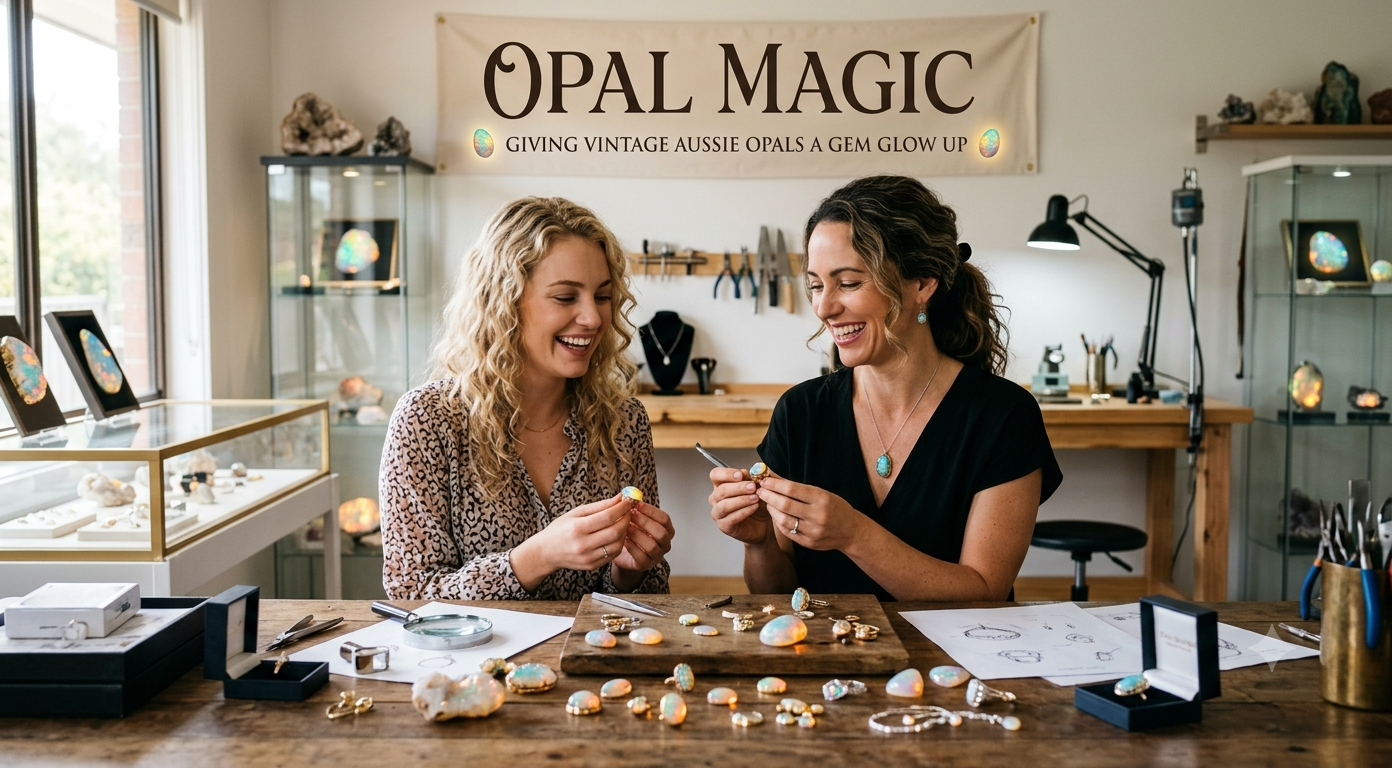
There is an unmistakable, almost hypnotic magic locked within an authentic Australian opal. Unlike diamonds that bounce brilliance off engineered facets, or emeralds that draw light into concentrated depths, an opal captures a dynamic, living galaxy within its matrix. Across the sun-scorched, iron-red expanses of Lightning Ridge, Coober Pedy, and the Queensland outback, nature spent over thirty million years trapping silica micro-spheres, ancient water, and prehistoric light into one of the rarest gemstone structures on the planet.
Yet today, millions of dollars worth of these historical national treasures lie dormant across Australia and around the world. Hidden in velvet boxes, forgotten inheritance drawers, or antique shop displays, fine vintage opals often sit obscured under decades of surface abrasion, outdated metal settings, and accumulated dust. Because opals possess a softer silicate structure, time can dull their surface shine, turning what was once a vibrant flash of neon red, peacock blue, or radiant yellow into a hazy, quiet stone.
At Gem Glow Up Australia, we believe that no heirloom opal should remain in the shadows. Through expert lapidary restoration, master goldsmithing, and bespoke contemporary redesign, our specialized Gem Glow Up service breathes new life into aged Australian opals. We bring historic gems out of retirement and transform them into modern, heirloom-quality showpieces designed to captivate for another lifetime.
Australia produces more than 95% of the world’s finest precious opals. The gems mined during the 20th-century boom periods—particularly from the 1950s through the 1980s—hold a legendary status among global gemmologists. During these peak mining eras, seams were unearthing extraordinary colors, vivid body tones, and rare pattern formations (such as broad flash, harlequin, ribbon, and straw pattern) from deposits that are now completely exhausted.
Owning a vintage Australian opal means possessing a finite piece of Earth’s geological history. However, because precious opal ranks between 5.5 and 6.5 on the Mohs Hardness Scale, decades of wear take a clear toll on their appearance.
Opal Classification
Black Opal
Boulder Opal
Crystal Opal
White/Milk Opal
Primary Origin
Lightning Ridge, NSW
Quilpie & Winton, QLD
Coober Pedy & Mintabie, SA
White Cliffs & Coober Pedy
Visual Characteristics
Dark body tone, vivid neon flash
Ironstone matrix, fluid organic shapes
Translucent body, spectral depth
Pale background, soft pastel play
Restoration Potential
High: Polishing unlocks contrast
Very High: Surface contouring
Exceptional: Internal light return
High: Clears surface cloudiness
Micro-Abrasions and Surface Scratches: Daily exposure to dust, air particles (which often contain quartz, rated at 7 on the Mohs scale), and contact with harder items creates thousands of microscopic scratches on the polished cabochon top. This diffuses incoming light before it can reach the silica spheres inside, making the stone appear flat or foggy.
Outdated and Restrictive Settings: Mid-century settings often utilized heavy, enclosed metal mountings or thick, aggressive prongs that cast deep shadows over the gem, effectively blocking side-light entrance and stifling the opal’s flash.
Accumulated Dirt and Oils: Over years of wear, skin oils, hand creams, hairsprays, and soap scum seep into the crevices under the stone, forming an opaque film behind translucent crystal opals that cuts off light transmission.
Edge Chipping: Unprotected vintage settings frequently leave the fine edges of an opal cabochon exposed to impacts, leading to micro-chipping along the girdle.
Restoring a delicate gemstone like an Australian precious opal is a specialized art form. Standard commercial jewelers often lack the lapidary equipment or gemmological experience necessary to work with opals safely. Subjecting an opal to inappropriate heat, harsh chemical baths, or high-vibration ultrasonic tanks can cause irreversible structural damage or cracking.
Our proprietary Gem Glow Up process is a meticulous five-phase restoration journey designed specifically for native Australian opals.
[ PHASE 1: Structural & Spectral Gem Mapping ]
│
▼
[ PHASE 2: Unsetting & Gentle Decontamination ]
│
▼
[ PHASE 3: Precision Lapidary Recutting & Polishing ]
│
▼
[ PHASE 4: Architectural Bespoke Redesign ]
│
▼
[ PHASE 5: Master Setting & Quality Assurance ]
Before touch meets tool, your opal undergoes a comprehensive gemmological examination under high-power optical magnification and polarized light. We evaluate:
Structural Integrity: Checking for internal crazing, stress lines, or cleavage vulnerabilities.
Color Topography: Mapping where the brightest color bars lie within the stone to ensure lapidary work enhances color exposure without diminishing carat weight.
Hydration Level: Verifying the stone’s stability for mechanical handling.
Using specialized micro-tools under magnification, our master goldsmiths carefully open vintage prongs or cut away old bezel walls without applying pressure to the gem. Once free, the opal undergoes a room-temperature organic bath that dissolves decades of organic oils, grime, and ancient adhesives without thermal shock.
This is the heart of the Gem Glow Up transformation. Working on variable-speed lapidary wheels coated with ultrafine diamond-grit paste, our master cutter removes only a fractional layer of silica—often less than a fraction of a millimeter—to buff out surface scratches and smooth micro-chips.
Next, using cerium oxide or tin oxide compounds on felt wheels, the cutter polishes the cabochon dome to a liquid glass finish. Instantly, the interior silica spheres re-align with light, releasing dormant electric reds, vivid blues, and fiery gold flashes that haven’t been seen in decades.
A restored gem requires a vessel worthy of its refreshed brilliance. Our design team works with you to sketch contemporary setting concepts tailored to your personal style and lifestyle requirements:
Modern Minimalist Bezels: Smooth, low-profile metal rims in 18k gold or platinum that protect the stone’s edges while accentuating clean geometric lines.
Floating Halo Designs: Setting subtle accent diamonds or native Australian green sapphires slightly below the opal’s perimeter to draw eyes directly to the gem’s internal fire.
Sculptural Asymmetry: Emphasizing the natural contours of unique Queensland Boulder Opals with fluid metalwork.
Using 100% recycled Australian gold, platinum, or sterling silver, our bench jewelers hand-craft the new mounting. The freshly polished opal is custom-set with extreme care, ensuring maximum security, light entrance, and protection against future everyday wear.
To understand the impact of a Gem Glow Up, consider these three actual restoration cases from our Melbourne and Sydney workshops:
The Original Piece: A 1960s heavy claw-set cocktail ring featuring a 4.2-carat Black Opal from Lightning Ridge. The stone surface was severely dull, scratched from decades of wear, and held in a tarnished, bulky setting that obscured its edges.
The Transformation: After unsetting, our lapidary polished away light micro-abrasions, revealing an intense electric red-and-green broad-pattern flash underneath the dull surface. The stone was reset horizontally into a sleek, satin-finished 18k yellow gold bezel ring with flush accent diamonds.
The Result: A modern luxury ring that highlights one of the rarest color combinations in gemmology, shifting from a dated costume look to a statement piece valued significantly higher than its original state.
The Original Piece: A mid-century Victorian-style cluster brooch passed down through three generations. The central translucent Coober Pedy crystal opal looked cloudy, milky, and completely devoid of fire due to grime accumulated underneath the mounting.
The Transformation: Deep cleaning cleared away fifty years of residue, while a light surface repolish restored the dome’s high luster. The opal was then adapted into an elegant, floating bezel-pendant on a fine 14k rose gold chain.
The Result: The light returned to the interior silica structure, casting vibrant spectral rainbows across the stone when exposed to natural daylight.
Restoring vintage jewelry is an investment in beauty, heritage, and ethics. Here is why discerning jewelry owners trust our Australian workshop:
Opals behave differently than diamonds, rubies, or sapphires. They possess water content and sensitive crystalline lattices. Our team consists of native Australian lapidaries and jewelers who have spent lifetimes working specifically with Australian opal varieties. We know how to read a stone’s grain, protect its water balance, and optimize its unique flash pattern.
Mining new gemstones carries an environmental footprint. By breathing fresh life into an existing vintage opal, you participate in the ultimate form of sustainable luxury. Upcycling pre-loved opals eliminates the need for new earth displacement while celebrating Australia’s rich jewelry heritage. Furthermore, all our custom metal settings are crafted from 100% recycled Australian precious metals.
Jewelry connects us to the people and moments that define our lives. A Gem Glow Up preserves the emotional connection of an inherited family piece while transforming its aesthetic so it fits seamlessly into modern wardrobes and daily life.
Once your vintage opal has completed its transformation, simple care habits will maintain its glassy luster and radiant play-of-color for generations:
Put Jewelry On Last: Apply perfumes, cosmetics, hairsprays, and body lotions before putting on your opal jewelry to avoid chemical buildup on the stone.
Avoid Submersion in Water with Chemicals: Remove opal rings before washing dishes, swimming in chlorinated pools, or bathing. While solid Australian opals are stable in water, harsh soaps and chlorine can leave deposits or damage metal mountings.
Never Use Ultrasonic Cleaners: High-frequency ultrasonic vibrations can induce micro-fractures in precious opals.
Clean Gentle at Home: Clean your piece using warm water, mild dish detergent, and an ultra-soft microfiber cloth or soft-bristle toothbrush.
Store in Soft Pouches: Keep your opal piece separated from harder gemstones (like diamonds, sapphires, and rubies) in a velvet-lined pouch to prevent surface scratching.
Can any vintage opal undergo a Gem Glow Up?
Most solid Australian opals (Black, Boulder, Crystal, and White opals) can be polished and reset. During Phase 1 of our process, we evaluate your gem for deep structural cracks or crazing to ensure it can safely withstand lapidary polishing.
Will my opal lose weight or size during repolishing?
The repolishing process removes an imperceptible amount of stone—typically just micro-layers off the top surface (often less than 1-2% of total carat weight). Our primary goal is always to maximize color display while preserving as much weight and structural thickness as possible.
What is the difference between solid, doublet, and triplet opals for restoration?
Solid opals are 100% natural opal throughout and can be fully repolished and recut. Doublets and triplets feature thin slices of opal glued to ironstone or glass backings with protective caps; while these can be cleaned and reset into new mountings, they require specific handling to avoid moisture damage to the glue layer.
Every vintage opal has a story waiting to be retold. Don’t let your family’s historic gems remain hidden in dark boxes when they could be radiating brilliant color every day.


© 2026 Gemglowup-au.com | All Rights Reserved