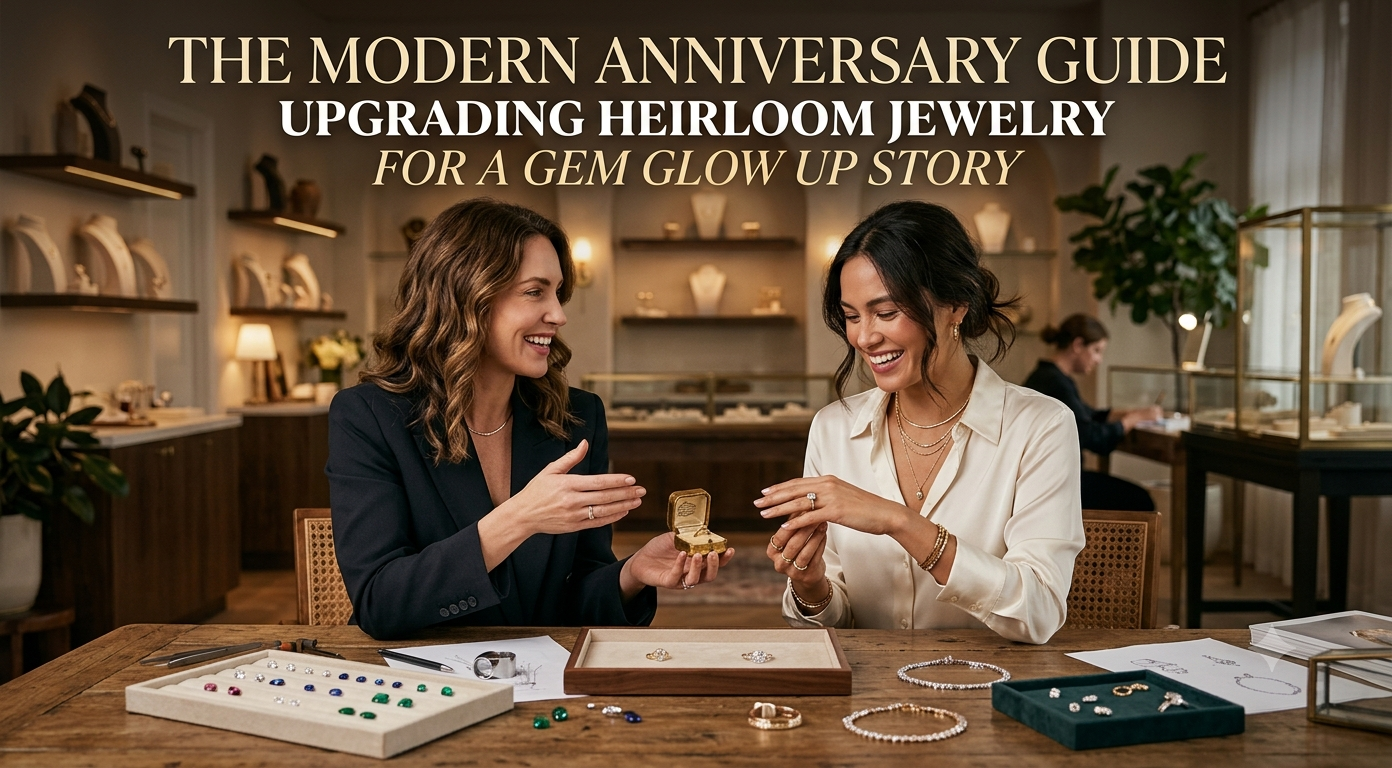
Inside every velvet box tucked away in a dark drawer lies a story waiting to be rewritten. Perhaps it is your grandmother’s heavy, ornate vintage cluster ring, a thick yellow gold bangle passed down by your mother, or the original engagement ring from your own wedding a decade or two ago. It carries immense emotional weight, but if we are being completely honest, it is gathering dust. The style feels dated, the setting catches on everything, or perhaps it simply doesn’t match the person you have evolved into today.
An anniversary is the ultimate milestone to reclaim that history. Welcome to your definitive guide to a Gem Glow Up in Australia—a movement celebrating the art of breathing breathtaking new life into heirloom jewelry, combining deep emotional heritage with striking, contemporary Australian design.
For decades, the standard approach to major wedding anniversaries was predictable: you went to a high-end showroom, browsed a glass case, and selected a completely new piece of jewelry. But modern luxury has fundamentally shifted. Today, luxury is defined by uniqueness, sustainability, and personal storytelling. A mass-produced ring from a catalog cannot compete with a piece that carries your actual ancestry in its stones.
A Gem Glow Up is not about erasing the past, ignoring a sentimental gesture, or rejecting an antique aesthetic. Instead, it is an act of preservation. It honors the core elements of your heirloom—the diamonds, the rare colored gemstones, the foundational gold—and rearranges the design architecture around them to mirror your lifestyle today.
Relationships are dynamic; they grow, shift, weather storms, and mature. The delicate, high-set engagement ring that suited a twenty-something bride may not fit the confident, established lifestyle of a woman celebrating her 10th, 20th, or 30th anniversary. Upgrading your jewelry on an anniversary aligns the evolution of your relationship with the physical evolution of your most symbolic possession. It serves as a beautiful checkpoint to look back at where you started while firmly anchoring yourself in who you are now.
Australia has some of the most rigorous environmental standards in the world, and Australian jewelry consumers are increasingly eco-conscious. Utilizing heirloom jewelry is the absolute pinnacle of sustainable luxury.
Zero New Mining Impact: By recycling your own gold and repurposing existing diamonds, you bypass the carbon footprint and ethical concerns associated with mining new materials.
Preserving Local History: Many heirloom gems found within Australian families feature beautiful historic cuts or old Australian sapphires that carry distinct regional signatures. Reusing them keeps that local heritage alive.
Value Retention: The major cost of fine jewelry lies in the gemstones. Reclaiming these assets means your budget is directed entirely toward premium local craftsmanship, bespoke design engineering, and high-quality precious metal alloys.
Before stepping into a designer’s studio, you need to conduct an audit of what you have. Think of this stage as gathering the raw ingredients for an exquisite, custom-cooked meal. Do not leave anything out based on appearance; even pieces you consider ugly, broken, or utterly unwearable possess incredible hidden value.
[ Family Estate Pieces ] + [ Broken Jewellery/Scraps ]
│
▼
[ Structural Evaluation & Sorting ]
│
┌──────────────┴──────────────┐
▼ ▼
[Gems for Extraction] [Gold for Refining/Trade]
Older diamonds are fascinating. If your heirloom dates from the late 19th century to the mid-20th century, you likely possess an Old Mine Cut or an Old European Cut diamond. These stones were faceted by hand under candlelight. They feature higher crowns, deeper pavilions, and larger open culets (the flat facet at the bottom of the stone). They do not sparkle with the sharp, white, laser-like brilliance of modern Round Brilliants; instead, they throw off broad, dramatic flashes of colored light, known as “fire.”
During your appraisal process, a master jeweler will check for:
Girdle Chipping: Older settings often clamped down hard on the edges of a diamond. Over decades of wear, minor chips can form.
Abraded Facets: While diamonds are incredibly hard, they can suffer microscopic scratching over a century of friction.
Recut Potential: If an antique stone is damaged, an expert diamond cutter can gently re-polish or slightly recut the stone. This restores its structural integrity and maximizes its natural glow without erasing its historic charm.
If your heirloom features a deep blue or green gemstone, there is a strong chance it is an Australian sapphire, mined in places like the Central Queensland Highlands or the New England region of New South Wales. Older Australian sapphires were often set in heavy, dark settings that blocked light from entering the stone, making them appear almost black.
A modern remodel can completely unlock these gems. By removing them from enclosed settings and placing them into open, minimalist mounts, light can flood the crystal structure, revealing hidden hues of teal, deep royal blue, and brilliant green that you never knew existed.
You might have broken chains, single earrings that lost their partners, or dental gold. All of this can be consolidated.
The Melt-Down Option: If you have an intense sentimental attachment to the exact physical metal your parents or grandparents wore, it can be melted down, purified, and recast. Note that doing this with white gold can be tricky due to old alloy compositions, and it may require extra refining.
The Credit Option: Most premium Australian jewelers will weigh your scrap metal, calculate its current market value based on carat weight, and apply that amount as a direct credit against the cost of your new design and fresh, ethically sourced Australian gold or platinum.
The Australian fine jewelry landscape is globally distinct. It steps away from the rigid, heavily traditional, ultra-symmetrical designs often favored in Europe or North America, leaning instead toward effortless elegance, raw organic beauty, and low-profile structural design. This aesthetic perfectly complements the active, indoor-outdoor lifestyle that Australians cherish.
When planning your Gem Glow Up, consider these prominent design philosophies currently shaping Australian studios:
This style is highly sought after for remodeling projects because it elegantly solves the problem of having mismatched stones. If you have inherited a collection of small round diamonds from one relative, a pear-shaped sapphire from another, and a baguette-cut diamond from an old wedding band, the asymmetric cluster brings them into absolute harmony.
Instead of forcing them into a stiff, artificial row, the designer arranges them in a scattered, organic cluster that mimics natural formations like sea foam, starlight, or river stones. The result is completely unique, artful, and unmistakably modern.
If you own an elongated stone—such as an oval, emerald, marquise, or radiant cut—the traditional way to set it is vertically, pointing up the length of your finger. A phenomenally popular modern upgrade is the East-West setting, which turns the gemstone 90 degrees so it sits horizontally across your finger.
Traditional Vertical Setting Modern East-West Setting
[ ] [======]
[ ]
(======) (======)
Finger Finger
This simple architectural rotation instantly updates the attitude of the stone. It shifts the vibe from formal and traditional to sleek, edgy, and contemporary, while visually widening the appearance of the band.
Classic vintage rings are notorious for high prongs that hold stones aloft like a claw. While this displays the stone prominently, it is highly impractical for daily life. High prongs snag on knitwear, scratch children, catch on car doors, and collect dirt rapidly.
Enter the Bezel Setting. A bezel is a solid frame of precious metal that wraps entirely around the perimeter of the gemstone.
Maximum Protection: It shields the vulnerable edges of your diamond or sapphire from impacts and chipping.
Visual Expansion: A polished gold or platinum bezel acts like a mirror frame, making your center stone look significantly larger than it actually is.
Daily Practicality: The surface is completely smooth, meaning you can wear your upgraded heirloom to the office, the beach, or out into the garden without a second thought.
Transforming a treasured family heirloom into a piece of contemporary art is an intimate journey that requires clear communication, technical precision, and absolute trust. Here is exactly what the step-by-step process looks like when working with an expert Australian custom jeweler.
The journey begins with an initial design consultation. This is where you bring your inspirations, your lifestyle notes, and your raw jewelry materials. Your designer will ask detailed questions about your habits:
Do you work with your hands or wear gloves often?
Do you prefer to stack multiple rings together, or do you want a single, standout statement piece?
Are you drawn to the warm, buttery tones of 18k yellow gold, the crisp modernity of platinum, or the romantic warmth of rose gold?
During this session, loose concept sketches are created to establish the overall silhouette and artistic direction.
Once you choose a general design direction, your heirloom pieces are officially logged into the studio’s secure inventory system. The jeweler will carefully extract the gemstones from their original mountings.
Once freed from the old metal, the gems are thoroughly cleaned in an ultrasonic bath and weighed on precise carat scales. They are then inspected under high-magnification microscopes to identify internal features, verify structural soundness, and determine precise millimeter dimensions. These exact measurements are critical for the next stage: digital blueprinting.
Modern custom jewelry design relies heavily on CAD (Computer-Aided Design) software. The jeweler builds a highly accurate, 3D digital model of your new ring, pendant, or earrings around the exact dimensions of your unique gemstones.
+————————————————————————————————–+
| CAD DESIGN CHECKLIST |
| [ ] Profile Height: Is the ring sitting low enough for daily wear? |
| [ ] Band Width: Is the metal proportioned beautifully to the gem? |
| [ ] Stacking Ability: Can a wedding or eternity band sit flush next to it? |
| [ ] Metal Color Contrast: Does the choice of metal highlight the stone? |
+————————————————————————————————-+
You will receive high-resolution digital renderings of the design from multiple angles. This stage allows you to make absolute changes before any metal is cast. If you want the band a fraction narrower, or if you want to shift the position of a side diamond, it can be adjusted with a few keystrokes. Some studios even offer a 3D-printed wax model of the design, allowing you to physically place the prototype on your finger to test the scale and fit.
Once you give formal approval to the CAD model, the physical creation begins. The digital file is used to grow a high-precision resin model, which is then placed into a casting flask. Molten precious metal—whether it’s refined heirloom gold or fresh Australian platinum—is poured into the mold using centrifugal or vacuum casting techniques.
A master setter then takes over the raw casting. Using specialized microscopes and hand tools, they cut precise seats into the metal for each individual stone, carefully pushing the gold or platinum over the gems to secure them flawlessly. Finally, the piece undergoes a multi-stage hand-polishing and texturing process, transforming it from a raw casting into a mirror-finished masterpiece.
The culmination of the journey is the collection day. Seeing a piece of jewelry that you have only ever known as a dated, dusty item transformed into a gleaming, magnificent expression of modern luxury is an intensely emotional experience. It is a moment where family history seamlessly bridges into your current life story.
To help visualize how your own jewelry collection could be radically reimagined, let’s explore three distinct transformation archetypes inspired by real Australian anniversary upgrades.
The Problem: Sarah inherited a traditional three-stone round diamond ring from her paternal grandmother, a damaged oval sapphire pendant from her maternal aunt, and had her own original thin 9k gold wedding band that she had outgrown. None of the pieces matched, and they all sat permanently in her safe.
The Modern Solution: For her 15th wedding anniversary, an Australian designer took all three elements and created an avant-garde, wide-band cluster ring. The oval sapphire was placed off-center in a modern bezel setting. The three family diamonds were arranged in a sweeping, staggered arc next to it, mimicking a constellation. The old gold bands were melted down and refined into a heavy, brushed-finish 18k yellow gold band that contrasted brilliantly against the gems.
The Outcome: A breathtaking, art-gallery-worthy statement ring that safely houses the memories of three generations of women in one unified, contemporary piece.
The Problem: For their 20th anniversary, David wanted to upgrade his wife Amanda’s original engagement ring. The ring featured a stunning 1.5-carat round brilliant diamond, but it was set in a late-1990s six-prong cathedral mount that stood nearly a centimeter off her finger. Amanda had stopped wearing it regularly because it constantly snagged on her clothing and struck surfaces during her daily routine as a landscape architect.
The Modern Solution: The center diamond was extracted and re-imagined into a bold, minimalist gypsy setting within a wide, tapered, flat-profile platinum band. To add a layer of secret romance, two small brilliant-cut sapphires (David’s birthstone) were set flush into the interior lining of the ring’s band, resting directly against Amanda’s skin.
The Outcome: A sleek, industrial-chic ring that feels completely weightless and secure on the hand. Amanda can wear it directly to project sites and formal dinners alike, keeping her commitment front and center every single day.
The Problem: James and Rebecca were celebrating their silver 25th anniversary. Rebecca had been gifted an intricate Edwardian-era platinum bar brooch encrusted with over thirty small rose-cut and old-mine diamonds. While stunning, the piece was entirely unwearable for their casual, coastal lifestyle in Byron Bay.
The Modern Solution: The jeweler meticulously deconstructed the brooch, safely harvesting all thirty-two accent diamonds.
The five largest diamonds were set horizontally into a modern, open-wire five-stone anniversary band meant for stacking.
The remaining twenty-seven smaller diamonds were used to create a stunning, delicate eternity bracelet on a fluid, minimalist white gold chain.
The Outcome: Instead of one large heirloom ornament locked away in a box, Rebecca received a complete, multi-piece contemporary jewelry suite that she styles effortlessly with casual linen outfits and evening wear alike.
Because heirloom jewelry carries irreplaceable emotional and financial value, you must approach the process with a clear understanding of the professional standards required to protect your investments.
When you leave your jewelry with a design studio, you should receive a formal, legally binding Intake Receipt. This document must include:
High-resolution photographs of your jewelry as it was delivered.
The exact weight of the total pieces in grams.
An initial count and estimated dimensions of all visible gemstones.
A clear note regarding any pre-existing damage, chips, or loose stones observed under the loupe.
A common anxiety when remodeling jewelry is the fear of stone switching. Reputable, high-end Australian jewelers completely eliminate this worry through transparency:
Laser Inscriptions: Most modern certified diamonds feature a microscopic laser inscription on the girdle containing their grading report number. Your jeweler will read this number to you under a microscope upon intake and verify it again when you pick up the finished piece.
Natural Inclusions: If your stone is an older cut without a laser inscription, it will have unique internal characteristics—such as a specific crystal inclusion, feather, or cloud. Your jeweler will map this “fingerprint” with you under a microscope during your consultation, ensuring you can immediately identify your exact diamond upon completion.
Once your design is complete, its legal and financial status changes completely. It is no longer a collection of loose components or an antique item; it is now a brand-new, bespoke contemporary creation.
Your jeweler should supply a formal Retail Replacement Valuation issued by a registered valuer (such as a member of the National Council of Jewellery Valuers in Australia). This document outlines the exact grade of the materials, the total diamond weight, the metal purity, and the current market cost to recreate the piece from scratch. You must forward this document to your specialized jewelry insurance provider immediately to ensure your new asset is fully covered from the moment it leaves the studio boutique.
Fine jewelry is unique among all human possessions. It does not wear out like fine clothing, it does not become obsolete like technology, and it does not decay like artwork. It is a permanent vessel for human emotion, memory, and love.
Leaving beautiful, historic gemstones locked away in a dark drawer out of a misplaced sense of obligation is a disservice to the people who wore them before you. They bought and wore those pieces to celebrate life, success, and love. By choosing a Gem Glow Up for your anniversary, you are actively honoring their memory by bringing their treasures back into the light of the living world.
You are combining the physical soul of your family’s history with the breathtaking artistry of modern design. The result is a piece of jewelry that is deeply meaningful, wonderfully practical, and completely stunning—a wearable testament to where you come from, how far you have traveled together, and where your love story is headed next.
Your family heirlooms deserve to shine in the daylight. If you are approaching a milestone anniversary and want to explore the possibilities of a custom modern transformation, book your private design consultation with our master artisans today. Together, let’s design a piece that tells your true story.


© 2026 Gemglowup-au.com | All Rights Reserved