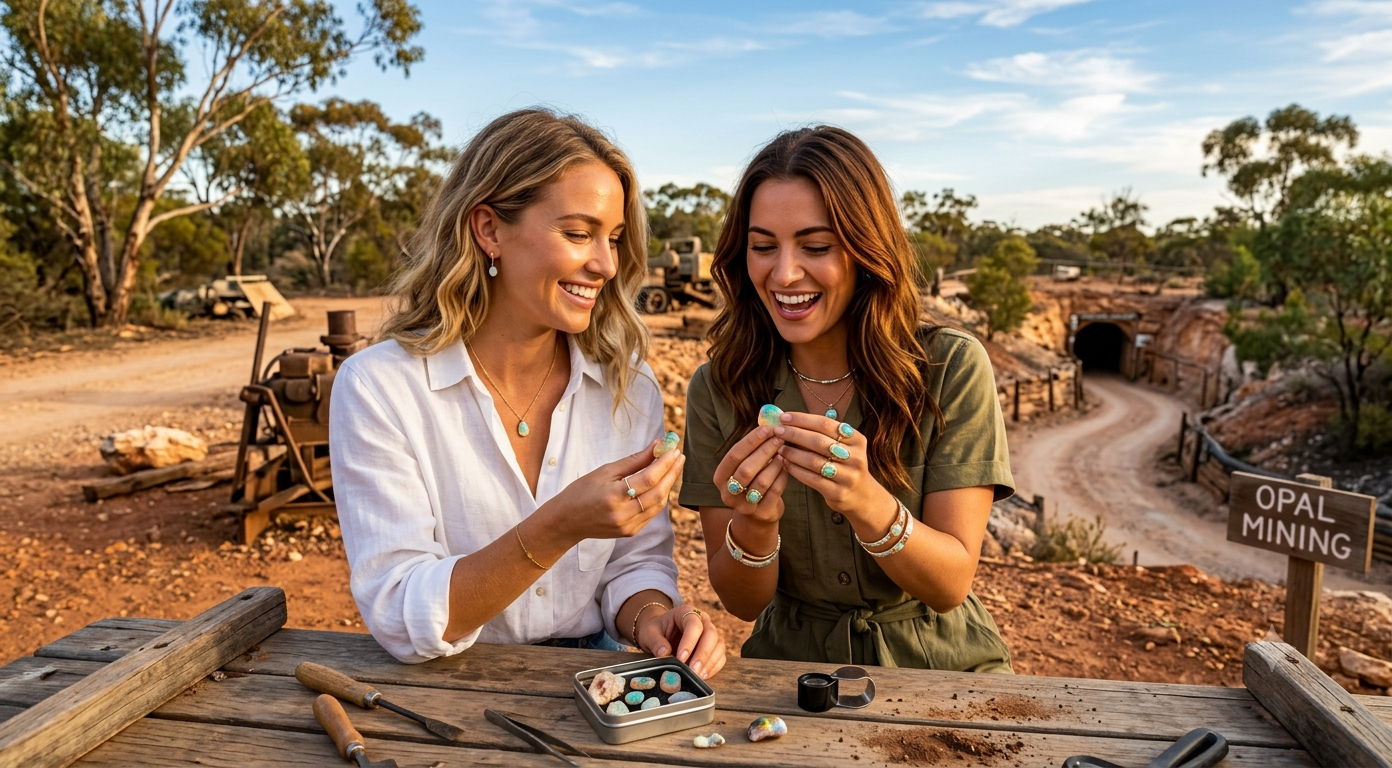
There is a land where the earth hides a secret spectrum of living light. Far from the bustling coastal metropolises of Sydney and Melbourne, past the jagged horizons of the Flinders Ranges, lies the vast, sun-baked infinity of the Australian Outback. Here, the ground is painted in shades of rust, ochre, and deep crimson. To the untrained eye, it is an unforgiving desert—a barren expanse where little survives and even less thrives. But beneath this ancient, weathered crust lies a subterranean treasure born of prehistoric inland seas, cosmic geometry, and millions of years of geological miracles: the Australian Opal.
For centuries, fine jewelry enthusiasts, fashion visionaries, and gemstone collectors have sought a truly transformative gemstone—a piece that does more than catch the ambient light of a room, but actively radiates its own inner life. If you are looking to elevate your jewelry collection from conventional, uniform luxury to an extraordinary, highly individualized statement of living art, it is time for a Gem Glow Up.
By choosing an authentic Australian opal, you aren’t just buying a stone; you are inheriting a piece of the cosmos, forged in the harsh, beautiful heart of Australia. It is a gemstone that defies duplication, mirrors your unique personal evolution, and possesses an undeniable, hypnotic glow that captivates anyone who catches its gaze.
To truly appreciate the sheer visual drama of an Australian opal, one must understand its tumultuous, millions-of-years-long origin story. Long before it catches the light on your finger, dances at your earlobes, or rests flat against your collarbone, an opal is shaped by the violent atmospheric and geological extremes of the Australian continent.
The journey begins over 140 million years ago during the Cretaceous period. At that time, the arid interior of Australia looked nothing like the desert we know today. Instead, it was covered by a massive, shallow, freezing body of water known as the Eromanga Sea, which formed a significant part of what is now the Great Artesian Basin. This vast inland sea was teeming with prehistoric marine life, from plesiosaurs to microscopic organisms.
Over vast eons, these prehistoric waters slowly receded, leaving behind a landscape rich in silica-heavy marine sediment, weathered sandstone, and decaying organic matter. As the climate shifted and the land dried into a severe desert environment, prolonged periods of torrential rain interspersed with blistering, bone-dry droughts created a unique subterranean pressure cooker. The rainwater, washing down through the sandstone, picked up soluble silica and carried it deep down into the cracks, fissures, faults, and underground cavities of the desert rock.
Opal is uniquely non-crystalline, differentiating it from almost every other precious gemstone on Earth. Instead of a rigid crystalline lattice like a diamond or sapphire, precious opal is composed of sub-microscopic spheres of amorphous silica arranged in a highly organized, tightly packed, three-dimensional grid.
When groundwater evaporated over millions of years—at a painstaking rate of just a few millimeters every five to ten million years—these tiny silica spheres hardened permanently in place.
When white light passes through these perfectly stacked spheres, it cannot travel in a straight line. Instead, it undergoes a complex physics phenomenon known as diffraction. The light is bent, split, and scattered into a vivid, shifting kaleidoscope of spectral colors. This breathtaking optical phenomenon is known universally as play-of-color.
The size and uniformity of the silica spheres dictate the exact colors you see:
Smaller spheres (around 150 to 200 nanometers in diameter) create cool, tranquil blues, deep violets, and subtle indigos.
Medium spheres (around 200 to 250 nanometers) bring out bright, electric greens and radiant, sunny yellows.
Larger spheres (300 nanometers and above), which are incredibly rare and highly prized, diffract the long-wave light rays to produce fiery, explosive oranges and hypnotic, blazing reds.
Because no two pockets of silica dried in the exact same manner, under the exact same pressure, or with the exact same sphere sizes beneath the Outback floor, no two opals are identical. Every single gem possesses its own unique optical fingerprint, making it the ultimate tool for personal expression and an authentic style transformation.
When embarking on your personal Gem Glow Up, the first step is discovering which specific variety of Australian opal aligns with your energetic frequency, skin undertones, and wardrobe palette. Australia proudly produces over 95% of the world’s precious gem-grade opal, split across three iconic, remote geographical hubs. Each region infuses its stones with a distinct personality.
Found almost exclusively in the isolated, dust-swirled outpost of Lightning Ridge, New South Wales, the Black Opal is widely considered the rarest, most valuable, and most alluring type of opal on Earth.
Do not let the name fool you: a black opal is not a dark, dull stone. Rather, it features a naturally dark gray, dark green, or jet-black body tone (known as the potch or common opal backing). This dark background acts exactly like a black velvet canvas, making the overlying neon blues, emerald greens, and rare crimson flashes explode with unparalleled, contrasting intensity. It is a gemstone of absolute drama.
The Vibe: Dramatic, mysterious, avant-garde, and ultra-luxurious.
Best For: Statement cocktail rings, high-fashion evening wear, and discerning collectors who demand the absolute pinnacle of organic luxury.
Style Styling Tip: Pair a Lightning Ridge Black Opal with a minimalist, monochromatic black wardrobe to let the neon flashes take center stage as a wearable work of art.
Mined out of the rugged, unforgiving, sun-cracked ironstone belts of Western Queensland (including historic, remote mining towns like Quilpie, Yowah, and Winton), Boulder Opal is a magnificent testament to the raw, rugged beauty of the Outback.
In a boulder opal, the precious vein of colorful silica is so thin and intricately intertwined with the surrounding rock that it cannot be separated from its host material without destroying it. Master cutters expertly fashion the gemstone to retain its natural, chocolate-brown ironstone backing. The result is a striking, organic juxtaposition: dark, earthy, texturally rich ironstone running alongside or underneath brilliant, ribboned veins of electric blue, neon green, and molten gold fire.
The Vibe: Earthy, bohemian, fiercely individualistic, and deeply artistic.
Best For: One-of-a-kind sculptural pendants, unisex jewelry designs, and those who appreciate a rustic, natural aesthetic with high-end impact.
Style Styling Tip: Complement a boulder opal’s natural ironstone matrix by pairing it with earth tones like terracotta, olive green, cream linens, and raw silk textures.
Hailing from the legendary, sun-bleached subterranean town of Coober Pedy, South Australia—where residents live in underground dugouts to escape the scorching surface heat—White and Crystal Opals offer a softer, more magical luminescence.
White opals feature a milky, translucent light-colored body tone that displays gentle, shifting pastel flashes of pink, neon yellow, sky blue, and mint green. Crystal opals, on the other hand, are completely transparent to semi-transparent. When light strikes a premium crystal opal, the colors seem to float suspended mid-air inside a drop of pure, liquid light, shifting dynamically as your body moves.
The Vibe: Ethereal, romantic, classic, and endlessly versatile.
Best For: Modern alternative bridal rings, delicate layering necklaces, everyday signature pieces, and an understated daytime glow.
Style Styling Tip: Set crystal opals in high-polish white gold or platinum alongside diamonds to emphasize their bright, watery brilliance and dreamlike clarity.
Transforming your style profile with an Australian opal is a deliberate, joyful journey. Because these stones are completely distinct from traditional faceted diamonds or monochrome emeralds, purchasing one requires a specific approach. Follow this structural guide to curate your perfect opal style transition and avoid common buying pitfalls.
1.Determine Your Primary Body Tone:Establishing the Canvas.
Decide whether your wardrobe and skin tone benefit from a dark, dramatic backdrop or an ethereal, bright one. If you wear deep jewel tones, leather, or structural dark clothing, choose a Black Opal or a dark Boulder Opal for high-contrast pop. If you prefer pastel linens, neutrals, or bridal creams, opt for a Crystal or White Opal for a softer finish.
2.Assess the Play-of-Color and Directionality:Evaluating the Fire.
Examine the stone under different lighting environments, including natural sunlight, warm indoor light, and moving ambient light. Look for a stone with high brightness (rated on an industry scale from 1 to 5, with 5 being brilliant and visible from across a room). Pay close attention to directionality—ensure the stone flashes its colors from multiple angles, rather than turning dull, dark, or gray when viewed from the side.
3.Select Your Preferred Pattern:Choosing the Artistic Voice.
Opals exhibit distinct arrangement patterns of color. Choose from the blocky, ultra-rare Harlequin pattern (geometric squares of color), the shifting sheets of Flash Fire (broad sweeps of color that appear and disappear), the delicate dots of Pinfire (tiny, starry points of light), or the sweeping brushstrokes of Ribbon patterns. Pick the pattern that mirrors your inner personality.
4.Pair with the Perfect Precious Metal:Framing the Outback Magic.
Work with a master jeweler to select a precious metal that complements your stone’s dominant flashes. White Gold and Platinum beautifully accentuate the cool blues, greens, and liquid clarity of crystal opals. Yellow Gold and Rose Gold draw out the warm red, orange, and bronze tones found in boulder opals and deep black opals, adding an antique warmth.
To help narrow down your selection, use this comparative guide outlining how the three primary variations of precious Australian opals stack up against each other across essential characteristics, helping you choose the right balance of rarity, durability, and style.
Opal Type | Primary Mining Location | Value & Rarity | Visual Signature | Care Level & Durability |
Black Opal | Lightning Ridge, New South Wales | Extremely High / Ultra-Rare | Vivid neon color flashes set against a dark gray or jet-black potch backing. Highly dramatic contrast. | Moderate (Solid stone; avoid abrasive surfaces) |
Boulder Opal | Queensland Fields (Winton, Quilpie) | High / Rare | Natural veins of precious opal permanently intertwined with rustic, rich brown ironstone matrix. | Highly Durable (The ironstone core provides natural structural reinforcement) |
White / Crystal | Coober Pedy, South Australia | Accessible to High / More Abundant | Ethereal pastel colors or floating translucent fire in a light, milky, or completely clear body tone. | Moderate (Solid stone; perfect for earrings and pendants) |
When you transition into the world of high-end Australian opals, you quickly realize that the traditional “Four Cs” of diamond grading (Carat, Clarity, Color, Cut) do not apply here. Opals are valued on a nuance-rich scale that feels much closer to fine art appreciation than scientific calculation. Beyond body tone and brightness, the pattern of the play-of-color is what drives collectors wild.
The arrangement of the color-diffracting silica spheres creates distinct visual designs across the face of the stone. Understanding these can help you spot a truly exceptional piece:
Harlequin: This is the holy grail of opal patterns. It features a regular, repeating mosaic or checkerboard layout of multi-colored, angular segments. A true, high-brightness Harlequin black opal is one of the rarest commodities on the global gem market, often commanding prices that rival or exceed flawless colored diamonds.
Straw or Palette: This pattern looks like abstract brushstrokes or scattered pieces of straw thrown across a dark floor. The colors intersect at wild angles, giving the stone an energetic, dynamic sense of movement.
Chinese Writing: Reminiscent of delicate calligraphic brushstrokes, this pattern features thin, interlocking lines of bright color that trace mesmerizing shapes across the stone. It appeals deeply to lovers of typography, structure, and graphic arts.
Chaff: This pattern features small, parallel bars of light clustered together, mimicking wind-blown husks of grain. It creates an incredible shimmering effect when the hand moves even a fraction of an inch.
Unlike diamonds, which are born deep in the earth’s mantle under intense heat and pressure, opals are delicate, organic treasures containing a small percentage of water (usually trapped within the silica structure between 3% to 10%). To maintain your gem’s brilliant glow up across generations and ensure it becomes an heirloom piece, you must treat it with mindfulness.
The Golden Rule of Opal Care: Solid Australian opals love being worn! They draw microscopic amounts of moisture from the ambient air and the natural oils of your skin, which keeps them hydrated and radiantly healthy. Do not lock them away in a dry box forever.
Cleaning: Never clean your opal jewelry using mechanical ultrasonic cleaners, steam cleaners, or harsh chemical solvents. The high-frequency vibrations of an ultrasonic cleaner can shatter the delicate structure of an opal. Simply wipe your jewelry down with a soft, clean, damp microfiber cloth and mild, chemical-free soapy water if necessary.
Storage: Avoid storing your opals in bone-dry, dark safes or directly underneath hot display lights for extended periods. If you live in an exceptionally arid climate or must store your jewelry in a safe, place a small, damp cotton ball or a small glass of water inside a sealed pouch with the opal. This safeguards the stone against crazing (developing tiny surface fractures due to dehydration).
Impact Awareness: Opal shares a similar hardness ranking to fine glassware (around 5.5 to 6.5 on the Mohs hardness scale). Always remove your opal rings and bracelets before engaging in strenuous physical activities, gym workouts, gardening, dishwashing, or heavy household cleaning.
When shopping for an authentic Gem Glow Up, ensure you are purchasing a solid Australian opal. Many mass-market retailers sell doublets (a thin slice of opal glued onto a black backing) or triplets (a thin slice of opal sandwiched between a black backing and a clear quartz or plastic dome).
While doublets and triplets offer an affordable look, they cannot tolerate water exposure, as moisture will dissolve the glue and turn the stone cloudy. A solid Australian opal, mined directly from the earth and shaped by a master lapidary, can be submerged in water without fear, holding its value and structural integrity forever.
An Australian opal is more than a mere luxury accessory; it is a portal to the raw majesty of the ancient earth, a piece of wearable modern art, and a sparkling testament to your own evolving personal style. It represents a shift away from mass production and a step toward authentic individuality. When you slide an authentic, ethically mined, and expertly cut Australian opal onto your finger, you aren’t just completing an outfit—you are finalizing your ultimate jewelry glow up.
Are you ready to discover the specific piece of the Outback that has been waiting millions of years just to meet you?
Yes. Australia has some of the strictest environmental and labor regulations for mining in the world. The vast majority of opal mining in regions like Lightning Ridge and Coober Pedy is conducted by small-scale, independent operators or family-run businesses using small machinery. They respect the land, strictly adhere to government rehabilitation laws to restore the natural desert environment after mining is completed, and ensure fair wages and safe working conditions.
Absolutely! Modern brides are increasingly turning away from traditional diamonds in favor of expressive, colorful gemstones. An opal engagement ring is incredibly romantic and uniquely yours. However, because opals are softer than diamonds, choose a protective setting—such as a bezel setting that wraps the stone in protective gold, or a low-profile halo design. Remember to remove it during rough hand activities to protect its pristine finish.
If a solid Australian opal turns slightly cloudy, it is usually due to microscopic surface scratches accumulated from years of loving wear. This can easily be resolved by taking the stone to a professional opal cutter, who can gently re-polish the surface dome to restore its original fiery brilliance. If a triplet or doublet turns cloudy, it means water has penetrated the glue layer, which unfortunately cannot be repaired. Always insist on buying solid stones with independent certificates of authenticity.
Yes, particularly for Black Opals and high-grade Boulder Opals. The known opal fields in Australia are finite, and finding top-gem-quality stones with brilliant fire and rare patterns becomes harder each year. As global demand from high-end luxury fashion houses increases and supply remains limited, premium Australian opals continue to be an excellent alternative asset and an investment-grade addition to any jewelry collection.


© 2026 Gemglowup-au.com | All Rights Reserved